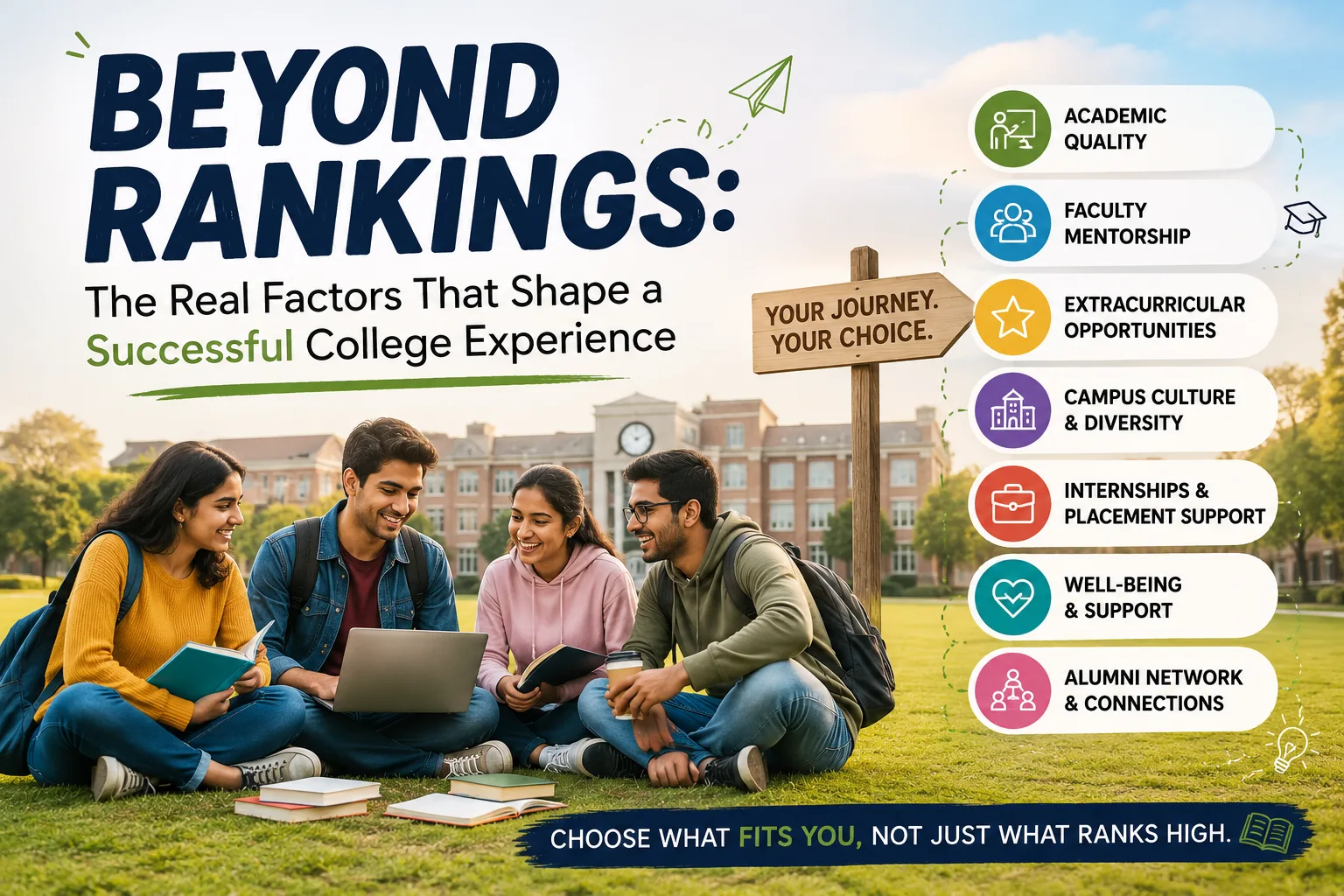
When students begin searching for colleges, the first question they often ask is, "Which college has the best ranking?" While rankings can provide a general overview of an institution's reputation, they don't always tell the complete story.
A college that ranks highly on paper may not necessarily be the best fit for every student. Likewise, many institutions with moderate rankings offer outstanding faculty, excellent industry exposure, strong placements, and a supportive learning environment that can significantly influence a student's future.
Success in college isn't determined by a single number or position on a ranking list. It is shaped by several factors that directly affect your learning, skill development, confidence, and career opportunities.
Let's look at the aspects that truly matter when choosing a college.
Quality of Faculty
One of the strongest indicators of a good college is the quality of its faculty.
Experienced professors don't just teach from textbooks—they encourage critical thinking, guide research, mentor students, and help bridge the gap between theory and practical application.
A supportive faculty can inspire students, clarify complex concepts, and provide valuable academic and career guidance throughout the course.
Industry Exposure
Today's employers value graduates who understand how industries operate.
Colleges that regularly organise internships, industrial visits, guest lectures, workshops, live projects, and collaborations with companies provide students with practical learning opportunities that go far beyond classroom education.
Industry exposure helps students understand workplace expectations and build confidence before entering their careers.
Internship Opportunities
Internships have become an essential part of higher education.
A college that actively supports internship opportunities allows students to:
- Apply classroom learning in real-world situations
- Build professional networks
- Improve technical and communication skills
- Strengthen their resume
- Explore different career paths
Even short internships can significantly improve employability after graduation.
Placement Support
Placement statistics often receive more attention than the actual placement process.
Instead of looking only at the highest salary package, evaluate:
- Placement percentage
- Average salary package
- Diversity of recruiters
- Internship-to-placement conversion
- Placement training programmes
- Career guidance services
A college that consistently prepares students for recruitment can create better long-term career outcomes.
Learning Beyond the Classroom
Higher education isn't limited to lectures and examinations.
Many successful students gain valuable experience by participating in:
- Student clubs
- Technical societies
- Entrepreneurship cells
- Research projects
- Hackathons
- Cultural activities
- Sports competitions
- Community service initiatives
These activities help students develop leadership, teamwork, communication, and organisational skills.
Campus Culture
Every college has its own learning environment and culture.
Some institutions encourage innovation and entrepreneurship, while others focus heavily on research, academics, or industry collaboration.
Before choosing a college, try to understand:
- Student diversity
- Campus environment
- Academic culture
- Faculty-student interaction
- Opportunities for personal development
A positive campus culture can make your college years both enjoyable and productive.
Modern Infrastructure
Infrastructure plays an important role in supporting quality education.
Look for facilities such as:
- Well-equipped laboratories
- Updated libraries
- Smart classrooms
- Innovation centres
- Research facilities
- Sports infrastructure
- High-speed internet
- Hostel facilities
Modern infrastructure creates better opportunities for practical learning and collaboration.
Student Support Services
Students often overlook the support systems available on campus.
A good college should provide services such as:
- Academic counselling
- Career guidance
- Placement support
- Mental wellness resources
- Skill development programmes
- Alumni mentoring
- Entrepreneurship support
These services contribute significantly to a student's overall growth and well-being.
Strong Alumni Network
A college's alumni often become one of its greatest strengths.
Successful alumni can:
- Mentor current students
- Share career advice
- Offer internship opportunities
- Refer graduates for jobs
- Build professional connections
A strong alumni network continues to add value long after graduation.
Accreditation and Recognition
Before applying, always verify whether the institution is recognised by the appropriate regulatory authorities.
Depending on the programme, check for approvals such as:
- UGC
- AICTE
- NAAC Accreditation
- NBA Accreditation
- Other professional councils where applicable
Recognition ensures the credibility and acceptance of your degree.
Location and Industry Connectivity
The location of a college can influence internship availability, networking opportunities, and exposure to industries.
Institutions located near major business hubs, manufacturing centres, IT parks, or research ecosystems often provide students with easier access to internships and industry interactions.
However, location should be considered alongside academic quality rather than as the only deciding factor.
Return on Investment (ROI)
An expensive college isn't always the best option.
Instead of comparing only tuition fees, evaluate the overall value offered by the institution.
Consider:
- Academic quality
- Placement outcomes
- Internship opportunities
- Industry exposure
- Infrastructure
- Student support
- Career growth
A college offering strong outcomes at a reasonable cost may provide a better return on investment than one with significantly higher fees.
How to Evaluate a College Effectively
Rather than relying only on advertisements or rankings, create a practical comparison checklist.
Evaluate each college based on:
- Course curriculum
- Faculty expertise
- Industry collaborations
- Placement support
- Internship opportunities
- Accreditation
- Infrastructure
- Campus culture
- Student reviews
- Alumni achievements
- Total cost of education
A structured comparison helps students make informed decisions based on facts rather than assumptions.
Common Mistakes Students Make
While selecting a college, many students unintentionally focus on the wrong priorities.
Some common mistakes include:
- Choosing a college only because of its ranking
- Following friends without proper research
- Ignoring accreditation
- Overlooking placement quality
- Not comparing course curriculum
- Ignoring internship opportunities
- Selecting based only on social media popularity
Avoiding these mistakes can lead to a more satisfying educational experience.
Final Thoughts
A successful college journey is shaped by much more than rankings or brand names. The quality of faculty, industry exposure, internships, campus culture, placement support, and student development opportunities all play a significant role in preparing students for life after graduation.
When choosing a college, look beyond promotional brochures and ranking tables. Research thoroughly, compare institutions using meaningful criteria, and focus on finding a college that aligns with your academic goals, career aspirations, and personal growth. The right environment can have a lasting impact on your education, confidence, and future success.