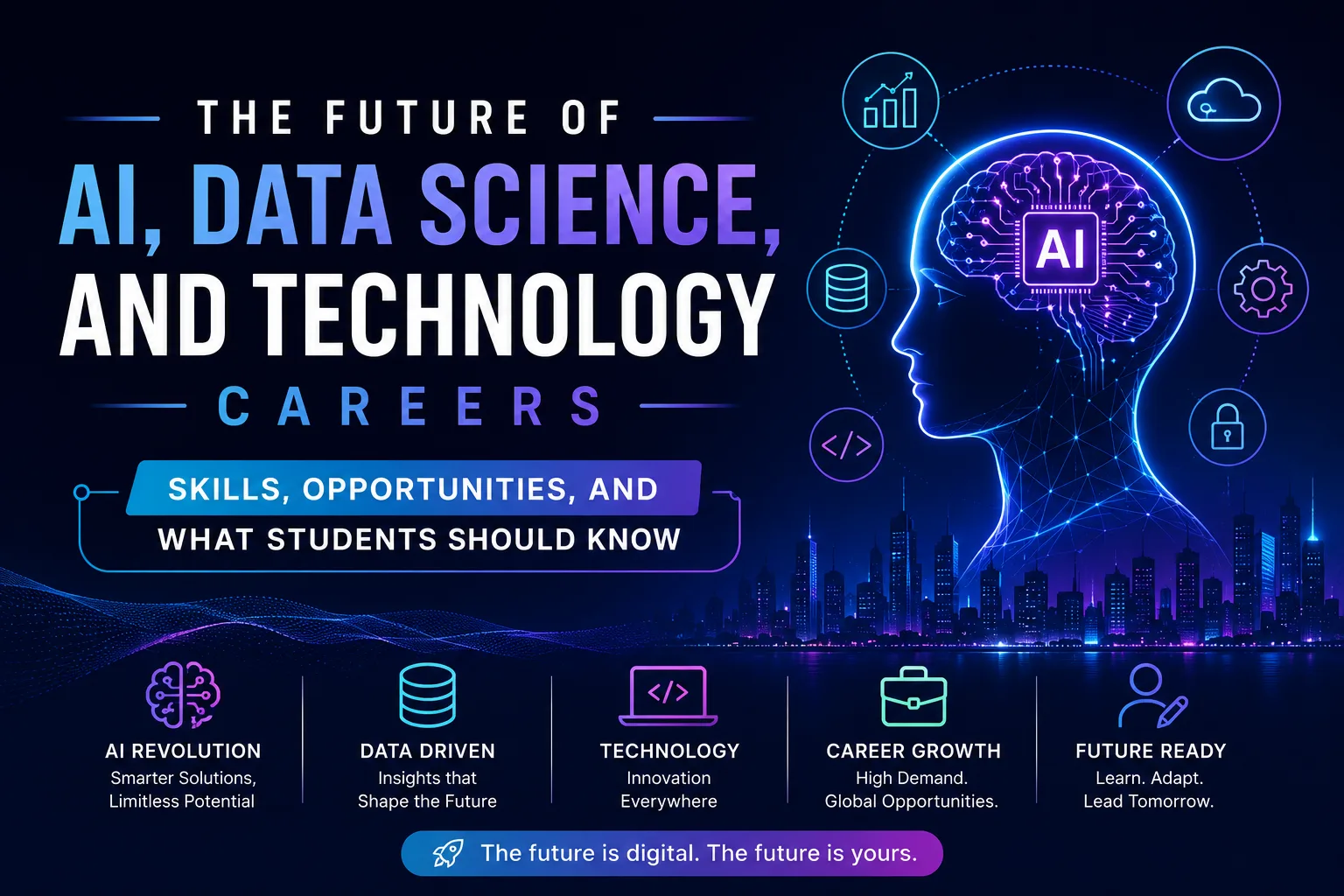
Technology is evolving faster than ever before, reshaping the way people work, learn, communicate, and solve problems. From healthcare and education to banking, manufacturing, agriculture, and entertainment, digital transformation has become a driving force behind innovation. At the heart of this transformation are technologies such as Artificial Intelligence (AI), Data Science, Machine Learning, Cloud Computing, Cybersecurity, and Automation.
As businesses continue to adopt advanced technologies, the demand for skilled professionals is increasing across industries. This has made technology-related careers some of the most exciting and dynamic career paths for students today.
However, succeeding in this field requires more than choosing a technology course. It involves developing the right skills, adapting to continuous change, and embracing lifelong learning.
Let's explore what the future of AI, Data Science, and technology careers looks like and how students can prepare for it.
Why Technology Careers Are Growing Rapidly
Organisations today generate enormous amounts of data and rely on technology to improve efficiency, reduce costs, enhance customer experiences, and make informed decisions.
Businesses are increasingly investing in:
- Artificial Intelligence
- Data Analytics
- Cloud Infrastructure
- Automation
- Cybersecurity
- Internet of Things (IoT)
- Robotics
- Digital Transformation
As a result, professionals who understand these technologies are becoming valuable across almost every industry—not just the IT sector.
Understanding Artificial Intelligence
Artificial Intelligence focuses on developing systems capable of performing tasks that traditionally require human intelligence.
AI is used in:
- Virtual assistants
- Recommendation systems
- Medical diagnosis support
- Fraud detection
- Autonomous vehicles
- Smart manufacturing
- Language translation
- Customer service automation
Rather than replacing every job, AI is increasingly helping professionals work more efficiently by automating repetitive tasks and supporting better decision-making.
What Is Data Science?
Data Science involves collecting, analysing, and interpreting large volumes of data to generate meaningful insights.
Companies use Data Science to:
- Understand customer behaviour
- Improve business strategies
- Predict market trends
- Optimise operations
- Detect risks
- Support decision-making
Because data is now considered one of the most valuable business assets, demand for professionals who can analyse and interpret it continues to grow.
Technology Is No Longer Limited to IT Companies
One of the biggest changes in recent years is that technology careers are no longer confined to software companies.
Today, AI and Data Science professionals work in:
- Healthcare
- Banking and Finance
- Retail
- E-commerce
- Manufacturing
- Agriculture
- Education
- Logistics
- Telecommunications
- Government organisations
- Media and Entertainment
This means students have opportunities to combine technology with almost any field that interests them.
Emerging Career Opportunities
As technology evolves, new career paths continue to emerge.
Some of the growing roles include:
- AI Engineer
- Machine Learning Engineer
- Data Scientist
- Data Analyst
- Business Intelligence Analyst
- Cloud Engineer
- Cybersecurity Analyst
- Robotics Engineer
- Software Developer
- DevOps Engineer
- AI Product Manager
- Prompt Engineer
- Computer Vision Engineer
- Natural Language Processing (NLP) Specialist
- AI Ethics and Governance Specialist
These roles require different combinations of technical knowledge, analytical thinking, and practical experience.
Skills That Matter Most
While technical knowledge is important, employers increasingly look for well-rounded professionals.
Key skills include:
Technical Skills
- Programming
- Database management
- Data visualisation
- Cloud platforms
- Machine Learning fundamentals
- Artificial Intelligence concepts
- Cybersecurity basics
- Software development practices
Professional Skills
- Communication
- Problem-solving
- Critical thinking
- Teamwork
- Adaptability
- Creativity
- Project management
Students who develop both technical and interpersonal skills are often better prepared for long-term career growth.
The Importance of Practical Learning
Technology is a hands-on field.
Students should actively participate in:
- Internships
- Open-source projects
- Coding competitions
- Hackathons
- Research projects
- Industry workshops
- Portfolio development
- Real-world case studies
Practical experience not only strengthens technical abilities but also demonstrates initiative during placements and job interviews.
Certifications Can Add Value
Professional certifications help students learn emerging technologies and validate their skills.
Depending on your career goals, certifications in areas such as cloud computing, cybersecurity, programming, data analytics, or AI can complement your academic education.
However, certifications should support practical learning rather than replace it.
Continuous Learning Is Essential
Technology changes rapidly.
Programming languages evolve, AI models improve, cybersecurity threats become more sophisticated, and new development frameworks emerge regularly.
Successful technology professionals make continuous learning a habit by:
- Reading technical blogs
- Taking online courses
- Building personal projects
- Following industry experts
- Participating in developer communities
- Experimenting with new tools
Learning doesn't stop after graduation—it becomes a lifelong process.
Will AI Replace Jobs?
This is one of the most common concerns among students.
The reality is more balanced.
AI is changing the nature of many jobs by automating repetitive and predictable tasks. At the same time, it is creating new roles that require human creativity, critical thinking, ethical decision-making, and technical expertise.
Students who learn how to work alongside AI tools rather than compete with them are likely to remain valuable in the future workforce.
The focus should be on developing skills that technology enhances rather than replaces.
Choosing the Right Course
Students interested in technology careers have several academic pathways.
Popular options include:
- B.Tech in Computer Science and Engineering
- B.Tech in Artificial Intelligence
- B.Tech in Data Science
- B.Tech in Information Technology
- BCA
- MCA
- B.Sc. Computer Science
- B.Sc. Data Science
- Software Engineering programmes
When comparing colleges, look beyond course names and evaluate:
- Curriculum
- Industry collaborations
- Internship opportunities
- Research facilities
- Placement support
- Laboratory infrastructure
- Faculty expertise
A practical, industry-oriented curriculum often provides better preparation than theoretical learning alone.
Common Mistakes Students Should Avoid
Many students enter technology courses with unrealistic expectations.
Some common mistakes include:
- Choosing AI only because it's trending
- Ignoring programming fundamentals
- Depending entirely on classroom learning
- Avoiding practical projects
- Neglecting communication skills
- Not building an online portfolio
- Failing to stay updated with new technologies
Building a successful technology career requires consistent effort and curiosity.
Preparing for the Future
Students who want to build successful careers in AI and technology should focus on developing a strong foundation rather than chasing every new trend.
Start by:
- Learning programming fundamentals.
- Building practical projects.
- Completing internships.
- Participating in coding competitions.
- Improving communication skills.
- Staying informed about industry developments.
- Creating a portfolio of your work.
- Networking with professionals and mentors.
These habits will help you remain adaptable as technology continues to evolve.
Final Thoughts
Artificial Intelligence, Data Science, and emerging technologies are shaping the future of work across every major industry. While the technology landscape will continue to evolve, one thing remains constant: organisations will always value professionals who can solve problems, think critically, learn continuously, and apply technology to create meaningful solutions.
Rather than focusing only on the latest trends, students should invest in building strong technical foundations, gaining practical experience, and developing the interpersonal skills needed to work in collaborative environments. The future belongs not only to those who understand technology but also to those who can use it responsibly, creatively, and effectively.
For students willing to embrace continuous learning, the opportunities in AI, Data Science, and technology are vast—and the journey is only just beginning.