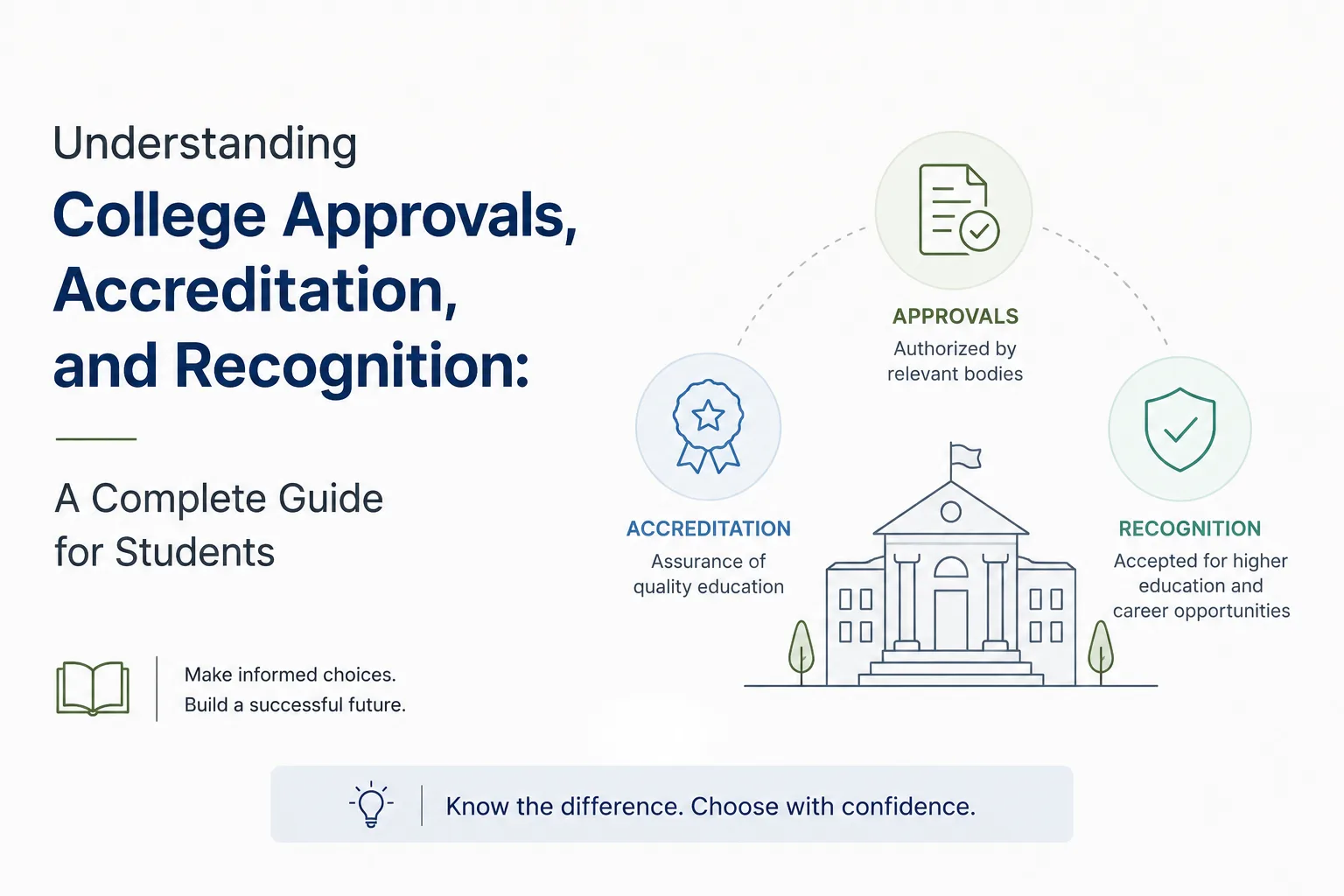
Choosing the right college is one of the most important decisions in a student's academic journey. While factors such as placements, infrastructure, faculty, and campus life are often discussed, one critical aspect is frequently overlooked—whether the college and its programmes are officially approved, recognised, and accredited.
Many students unknowingly apply to institutions without checking these details, only to face difficulties later while applying for higher studies, government jobs, professional licensing, or employment opportunities.
Understanding approvals, accreditation, and recognition helps you make an informed decision and ensures that your degree carries value wherever your career takes you.
Why Are College Approvals and Accreditation Important?
A recognised and accredited institution demonstrates that it meets specific academic, administrative, and quality standards established by regulatory authorities.
Choosing a properly approved institution can help ensure:
- Validity of your degree
- Eligibility for higher education
- Acceptance by employers
- Eligibility for government recruitment (where applicable)
- Access to scholarships and financial aid (subject to scheme requirements)
- Better academic quality and institutional accountability
Verifying these details before admission is an important part of responsible college selection.
Understanding the Difference
Although these terms are often used interchangeably, they have different meanings.
Recognition
Recognition means that an institution has been officially established or acknowledged by the appropriate authority to offer educational programmes.
Without proper recognition, the validity of a degree may be affected depending on applicable regulations.
Approval
Approval generally refers to permission granted by the relevant regulatory authority to offer specific programmes or professional education.
Certain technical, medical, legal, pharmacy, teacher education, and other professional courses require approvals from their respective regulators.
Accreditation
Accreditation is a quality assessment process that evaluates how well an institution or programme meets defined academic standards.
It focuses on aspects such as:
- Teaching quality
- Faculty
- Infrastructure
- Research
- Student support
- Learning outcomes
- Governance
- Continuous improvement
Accreditation helps students compare institutions based on educational quality rather than popularity alone.
Major Regulatory Bodies Students Should Know
Different types of colleges and courses are regulated by different organisations. Understanding their roles can help you verify whether a programme is offered under the appropriate framework.
University Grants Commission (UGC)
The University Grants Commission (UGC) is one of India's primary higher education regulatory bodies. It recognises universities and promotes standards in higher education.
Students should verify whether a university is recognised by the UGC before applying. UGC recognition is an important indicator that the institution operates within the country's higher education framework.
All India Council for Technical Education (AICTE)
The All India Council for Technical Education (AICTE) oversees technical education in areas such as engineering, management, architecture, hotel management, pharmacy (in coordination with relevant regulators), and other technical programmes.
Students considering technical or professional education should check whether AICTE approval is applicable to their chosen programme.
National Assessment and Accreditation Council (NAAC)
The National Assessment and Accreditation Council (NAAC) evaluates higher education institutions based on quality standards.
NAAC assesses factors such as:
- Curriculum
- Teaching and learning
- Research
- Infrastructure
- Student support
- Governance
- Innovation
Institutions receive accreditation grades based on their performance during the assessment process. These grades help students understand the overall quality systems of an institution.
National Board of Accreditation (NBA)
The National Board of Accreditation (NBA) focuses on the accreditation of individual technical and professional programmes rather than entire institutions.
NBA accreditation evaluates programme quality, curriculum, faculty expertise, learning outcomes, and industry relevance.
Students pursuing engineering and other technical disciplines may find NBA accreditation particularly useful when comparing programmes.
National Medical Commission (NMC)
Medical colleges offering MBBS and other regulated medical programmes are governed by the National Medical Commission (NMC).
Students planning careers in medicine should verify that both the institution and the programme comply with applicable NMC requirements.
Pharmacy Council of India (PCI)
The Pharmacy Council of India (PCI) regulates pharmacy education and professional standards.
Students interested in pharmacy courses should ensure that the programme is approved where required under applicable regulations.
Bar Council of India (BCI)
Law programmes intended to prepare students for legal practice generally require approval from the Bar Council of India (BCI).
Students planning to pursue legal careers should verify that their chosen law programme meets the relevant requirements.
Indian Nursing Council (INC)
The Indian Nursing Council (INC) oversees nursing education and helps maintain educational standards for nursing programmes.
Students applying for nursing courses should confirm compliance with the applicable regulatory framework.
National Council for Teacher Education (NCTE)
Teacher education programmes such as B.Ed. and related qualifications are regulated by the National Council for Teacher Education (NCTE).
Students aspiring to become teachers should verify that their chosen institution has the required approvals where applicable.
How to Verify College Recognition
Before submitting your application, take time to verify official information instead of relying solely on advertisements or social media posts.
A practical verification process includes:
- Visiting the institution's official website.
- Checking the approvals and accreditation section.
- Verifying information through the websites of the relevant regulatory authorities.
- Reviewing the institution's latest accreditation status.
- Confirming that the specific programme you are applying for meets applicable requirements.
Spending a few minutes on verification can prevent significant issues later.
Why Accreditation Matters for Students
Accreditation reflects an institution's commitment to maintaining educational quality.
Accredited institutions often demonstrate strengths in areas such as:
- Academic planning
- Teaching standards
- Research environment
- Student development
- Infrastructure
- Continuous improvement
- Industry engagement
While accreditation alone should not determine your decision, it is an important factor to consider alongside placements, faculty, curriculum, and student support.
Common Mistakes Students Make
Many students overlook regulatory details during admissions.
Some common mistakes include:
- Assuming every college is automatically recognised.
- Confusing recognition with accreditation.
- Not checking programme-specific approvals.
- Depending only on advertisements.
- Ignoring the latest accreditation status.
- Focusing only on rankings or social media popularity.
Avoiding these mistakes helps ensure your education is built on a strong and recognised academic foundation.
A Simple College Verification Checklist
Before confirming your admission, ask yourself:
✔ Is the university officially recognised?
✔ Does the programme require approval from a regulatory body?
✔ Has the institution been accredited?
✔ Is the accreditation current?
✔ Does the college publish approval details transparently?
✔ Does the programme align with your career goals?
✔ Have you verified the information through official sources?
A few simple checks today can save years of future complications.
Final Thoughts
Selecting a college is about much more than infrastructure, placements, or rankings. Ensuring that an institution is recognised, its programmes are approved where required, and it has credible accreditation provides confidence that your education meets established quality standards.
Before making your final decision, always verify official information, understand the regulatory framework applicable to your chosen course, and compare colleges on multiple factors—not just reputation. A well-informed decision today can protect your academic investment and support your career goals for years to come.