For many college students, internships have become another item on the career checklist:
Complete an internship. Get the certificate. Add it to the resume. Move on.
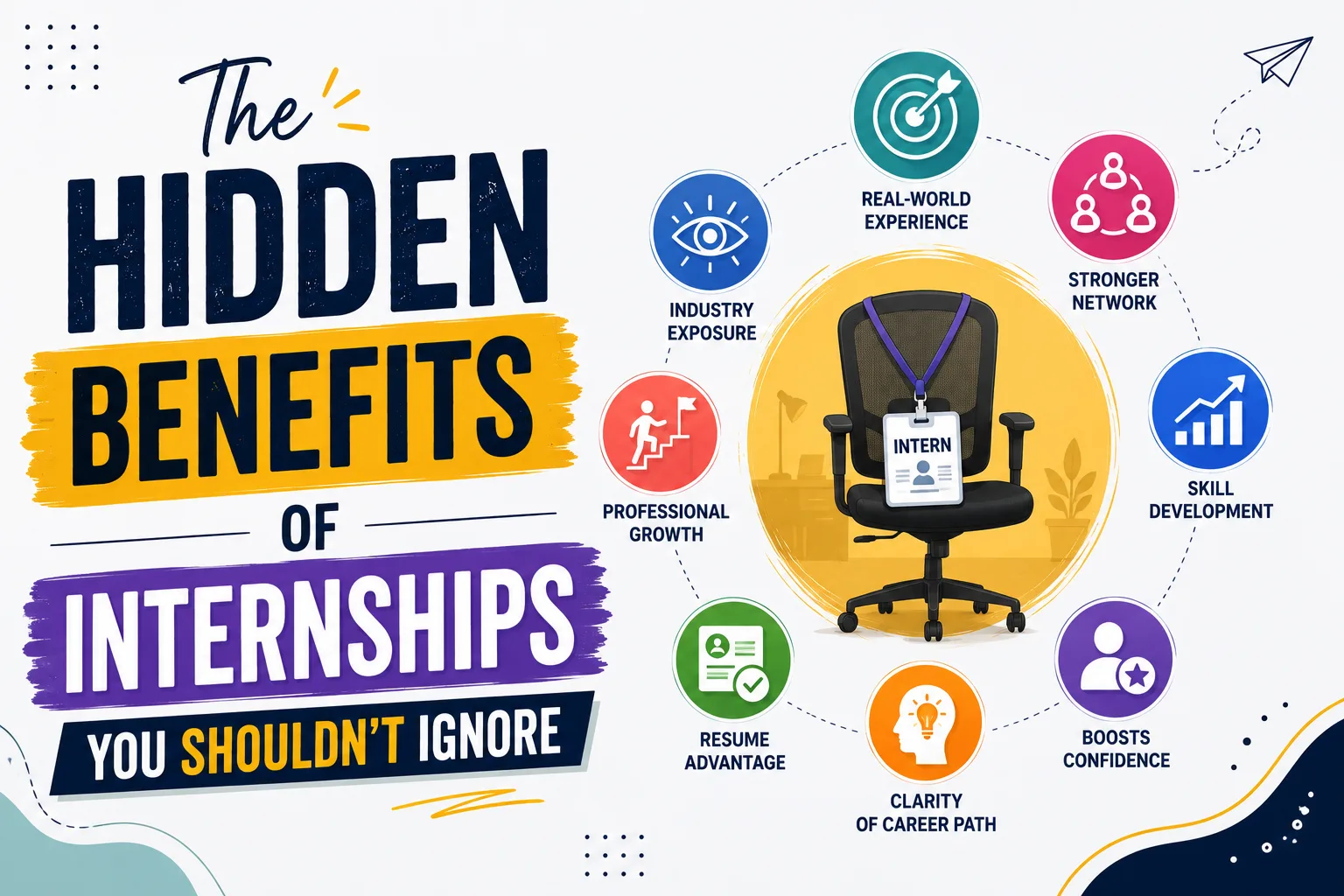
But when approached seriously, an internship can offer something much more valuable than a certificate.
It can show you whether you actually enjoy the career you're preparing for.
It can expose weaknesses you didn't know you had. It can introduce you to professionals who influence your future. It can teach you how workplaces function before your first full-time job.
And sometimes, discovering what you don't want to do can be just as valuable as finding what you love.
Here are some of the hidden benefits of internships that students often overlook.
1. You Discover What a Career Is Actually Like
Career descriptions can sound exciting online.
Marketing appears creative. Software development looks innovative. Finance seems analytical. Consulting sounds dynamic.
But reading about a profession and actually experiencing its daily work are completely different.
An internship gives you exposure to real responsibilities, deadlines, meetings, tools and expectations.
You may discover that a career you had been considering for years doesn't match your personality. Or you may find an area you had never seriously considered before.
That clarity can prevent a much more expensive career mistake later.
2. You Learn Things Classrooms Cannot Fully Teach
College builds theoretical foundations, but workplaces introduce different challenges.
A textbook may teach you how marketing works. An internship might ask you to analyse why an actual campaign is underperforming.
A programming course may teach a language. A development internship may require you to understand someone else's code, collaborate with a team and fix problems within deadlines.
Internships help connect:
What you know → with what you can actually do.
That transition from knowledge to application is one of their greatest benefits.
3. You Discover Your Skill Gaps Early
College can sometimes make you feel prepared because you're performing well academically.
Then you enter an internship and realise:
Your Excel skills aren't as strong as you thought.
You struggle to explain your ideas clearly.
Your presentations need improvement.
You understand programming concepts but struggle with practical projects.
You don't know how to write a professional email.
This may initially feel uncomfortable, but discovering these weaknesses while you're still a student is extremely useful.
You have time to improve before placements begin.
4. You Build Professional Confidence
The first professional meeting can feel intimidating.
So can sending your first formal email, presenting work to a manager or speaking with a client.
But each experience makes the next one easier.
Internships gradually teach you how to:
- Communicate professionally
- Ask questions
- Participate in meetings
- Accept feedback
- Present your work
- Take responsibility
- Deal with mistakes
By the time you enter a full-time role, the professional environment doesn't feel completely unfamiliar.
5. You Understand How Workplaces Really Function
College assignments usually have clear instructions.
Workplaces aren't always like that.
Sometimes the instructions are incomplete. Priorities change. Multiple people need updates. Deadlines move. A task you completed may need several revisions.
Internships expose you to these realities.
You begin understanding concepts such as:
- Reporting structures
- Team coordination
- Deadlines
- Professional etiquette
- Performance expectations
- Workplace communication
- Accountability
These lessons are difficult to learn through lectures alone.
6. You Learn How to Receive Feedback
Receiving feedback on an assignment and receiving feedback on professional work can feel very different.
A manager may tell you that your presentation isn't clear enough or that your analysis needs to be redone.
Your first reaction might be disappointment.
Over time, internships teach you to separate feedback about your work from judgement about your ability.
Instead of thinking:
“I'm bad at this.”
You begin asking:
“What exactly should I improve?”
That mindset becomes extremely valuable throughout your career.
7. You Build a Professional Network Before Graduation
One of the most overlooked benefits of internships is access to people.
During an internship, you may interact with:
- Managers
- Team leaders
- Founders
- HR professionals
- Other interns
- Clients
- Industry specialists
These relationships may later lead to mentorship, recommendations, career advice or information about opportunities.
But networking should not mean messaging everyone after your internship asking for a job.
Do good work. Be curious. Stay professional. Keep meaningful connections alive.
Strong professional relationships develop naturally from credibility.
8. You Get Better at Interviews Without Realising It
Internships give you actual experiences to discuss during interviews.
Consider the difference between these two responses:
“I'm good at teamwork.”
versus:
“During my internship, our team had three days to complete a client presentation. I handled the research and coordinated with the design team to finish it before the deadline.”
The second answer demonstrates the skill through experience.
Internships give you real examples for questions about:
- Teamwork
- Leadership
- Problem-solving
- Conflict
- Deadlines
- Failure
- Achievements
- Communication
That can make interview responses more convincing.
9. You Understand Which Skills Employers Actually Value
Students often collect certifications without knowing which skills are genuinely useful in their target industry.
An internship changes that.
You see what professionals actually use every day.
For one role, Excel and communication may matter more than five certificates.
For another, SQL, Python and data visualisation may be essential.
A design internship may reveal the importance of portfolio quality.
A marketing internship may show you that analytical ability matters alongside creativity.
This helps you become more selective about what you learn next.
10. You May Discover Careers You Didn't Know Existed
Students generally know the obvious professions.
Engineering.
Marketing.
Finance.
Law.
Design.
But organisations contain dozens of specialised roles that students may never encounter during school.
An internship could introduce you to areas such as:
- Product management
- Business analytics
- Customer success
- User research
- Supply-chain planning
- Performance marketing
- Risk analysis
- Compliance
- Product design
- Operations strategy
Sometimes your ideal career isn't the one you originally entered the internship to explore.
11. You Learn Whether You Prefer Startups or Large Companies
Work environment matters almost as much as job function.
A startup may give an intern broad responsibilities and faster exposure to different tasks. A large organisation may provide more structured processes, specialised teams and established systems.
Neither environment is automatically better.
An internship helps you understand whether you prefer:
Structure or flexibility
Specialisation or variety
Established processes or experimentation
Knowing your preferred environment can improve future job decisions.
12. You Build Evidence for Your Resume
Recruiters generally learn more from what you did during an internship than from simply seeing the company name.
Compare:
Marketing Intern – XYZ Company
with:
Analysed campaign performance across multiple channels and prepared weekly reports used to identify underperforming content.
The second description gives evidence of actual responsibility.
Internships can provide measurable experiences, projects and outcomes that make a student's resume more meaningful.
13. Internships Can Improve Your Academic Learning
The relationship works both ways.
Academics help you understand internships, but internships can also make classroom concepts easier to understand.
A finance concept becomes more meaningful after seeing financial reports.
Database concepts make more sense after working with real datasets.
Marketing theories become easier to understand after seeing customer campaigns.
When students return to class after practical exposure, they often understand why certain concepts matter.
14. You Learn Professional Time Management
In college, delaying an assignment might affect your own grade.
At work, delays can affect other people.
Your teammate may be waiting for your research before completing a presentation. Your manager may need your analysis before a meeting.
Internships teach you that deadlines are interconnected.
You learn to:
- Estimate how long tasks require
- Prioritise responsibilities
- Communicate delays
- Break large tasks into smaller steps
- Manage multiple deadlines
These habits become valuable long after the internship ends.
15. A Good Internship Can Lead to Future Opportunities
Internships do not guarantee jobs, and students should be cautious about any organisation promising guaranteed employment simply for joining an internship.
However, strong performance can sometimes lead to:
- Extended internships
- Future project opportunities
- Recommendations
- Referrals
- Pre-placement opportunities
- Full-time roles after graduation
Even when the same company doesn't hire you, the experience can strengthen applications elsewhere.
The Unexpected Benefit: Discovering What You Don't Want
Imagine spending years preparing for a career only to discover after graduation that you dislike the actual work.
An internship can reveal that much earlier.
Maybe you thought you wanted investment banking but dislike the work environment.
Perhaps you wanted software development but realise you enjoy product strategy more.
Maybe you considered marketing but discover that analytics interests you more than creative campaigns.
An internship that changes your career direction hasn't necessarily failed.
It may have saved you years.
How to Choose an Internship That Actually Helps
Not every internship provides meaningful learning.
Before accepting one, investigate:
What will I actually do?
Who will supervise me?
Will I work on real tasks or only observe?
What skills can I realistically develop?
Does this relate to a career I want to explore?
Can I manage the workload alongside college?
Be particularly careful with opportunities where the primary responsibility is unrelated sales, recruitment or promotional work despite being advertised under a completely different job title.
Read the role description carefully before applying.
Paid vs Unpaid: What Should Matter?
A paid internship is naturally attractive and can make opportunities more accessible to students.
However, compensation should not be the only factor you evaluate.
Consider the complete value:
Learning + responsibilities + mentorship + relevance + compensation + time commitment
An internship paying well but teaching you almost nothing may contribute less to your career than a genuinely educational opportunity.
At the same time, students should not assume unpaid work is automatically valuable because it provides “exposure.” Your time has value too.
Evaluate the opportunity realistically.
Don't Collect Internships—Build Experience
Three internship certificates don't automatically beat one meaningful internship.
Recruiters may ask:
What did you actually do?
What problem did you solve?
What did you learn?
What was your contribution?
If you cannot answer those questions, the certificate itself has limited value.
Choose experiences that allow you to build genuine skills and stories you can confidently discuss.
Making Your Internship Count
An internship becomes valuable when you treat it as more than a resume requirement.
Ask questions.
Understand why you're completing a task, not simply how.
Request feedback.
Observe how experienced professionals communicate.
Keep track of your projects and achievements.
Build relationships with people you genuinely learn from.
And after the internship ends, reflect on three questions:
What did I enjoy?
What was I good at?
What do I need to improve?
Those answers can influence your next internship, course, skill and eventually your career.
Final Takeaway
The biggest benefit of an internship may not be the certificate you receive at the end.
It may be discovering a career you didn't know existed.
It may be learning that your dream career isn't actually right for you.
It may be meeting a mentor, recognising a weakness, gaining confidence or finally understanding how classroom knowledge connects with real work.
Internships allow students to experiment with professional life before making permanent career decisions.
So don't ask only:
“Will this internship look good on my resume?”
Ask something more valuable:
“What will I know, understand or be able to do after this internship that I cannot do today?”
That's where the real value begins.