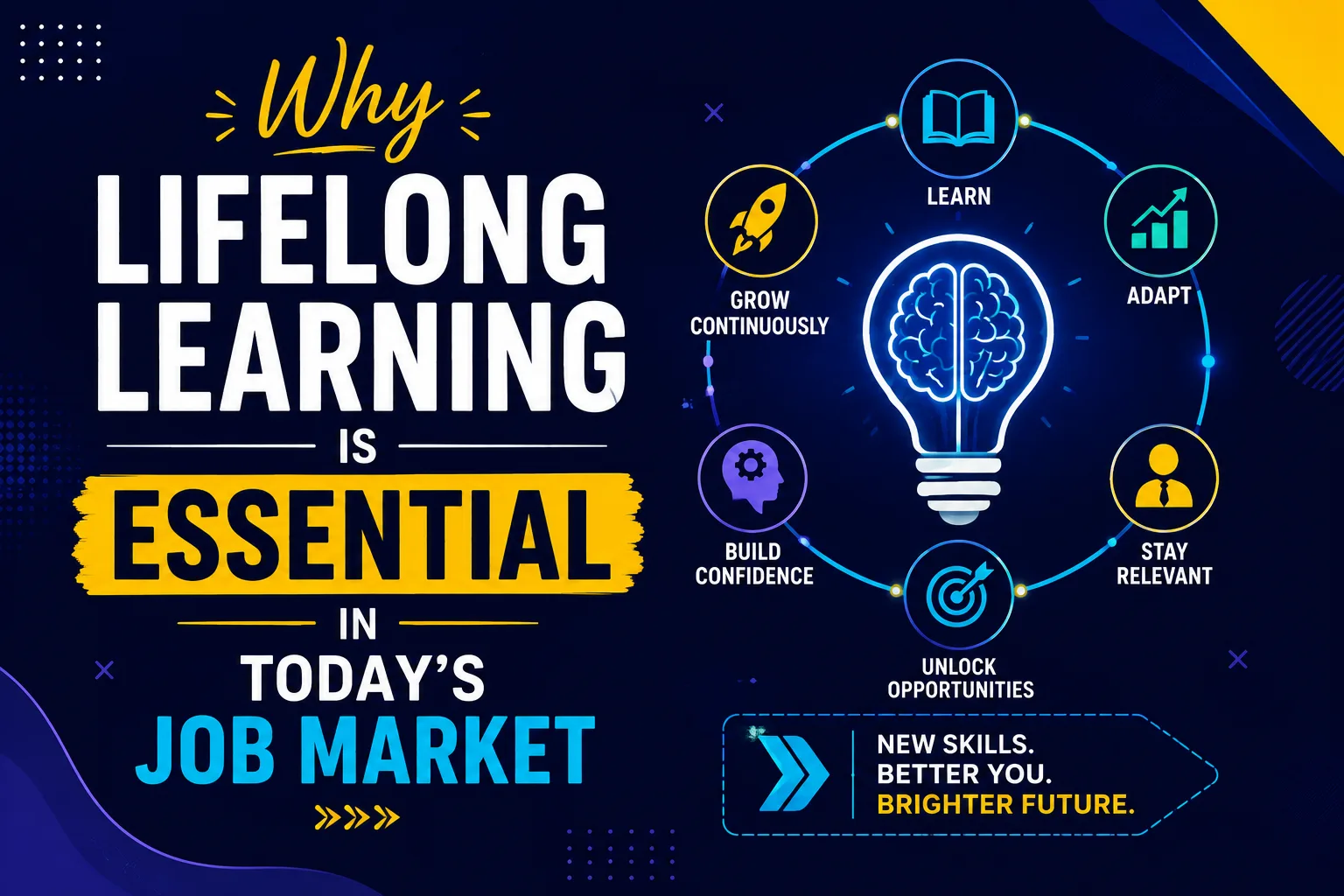
Why Lifelong Learning Is Essential in Today’s Job Market
Graduation is no longer the end of learning. As technology, AI and workplace expectations continue to change, professionals need to keep developing new skills throughout their careers. Lifelong learning helps you stay relevant, adaptable and ready for opportunities that may not even exist today.
✍️ Kollege Next Editorial Team📅 15 Aug 2026📁 Student Guide
There was a time when career planning seemed relatively straightforward.
Earn a degree. Get a job. Gain experience. Move up.
Today, that path looks very different.
Technology is changing how businesses operate. Artificial intelligence is transforming everyday tasks. New job roles are emerging while existing ones are being redesigned. Tools that professionals relied on five years ago may no longer be enough five years from now.
This creates an important reality for students and professionals:
Your education cannot stop when your formal education ends.
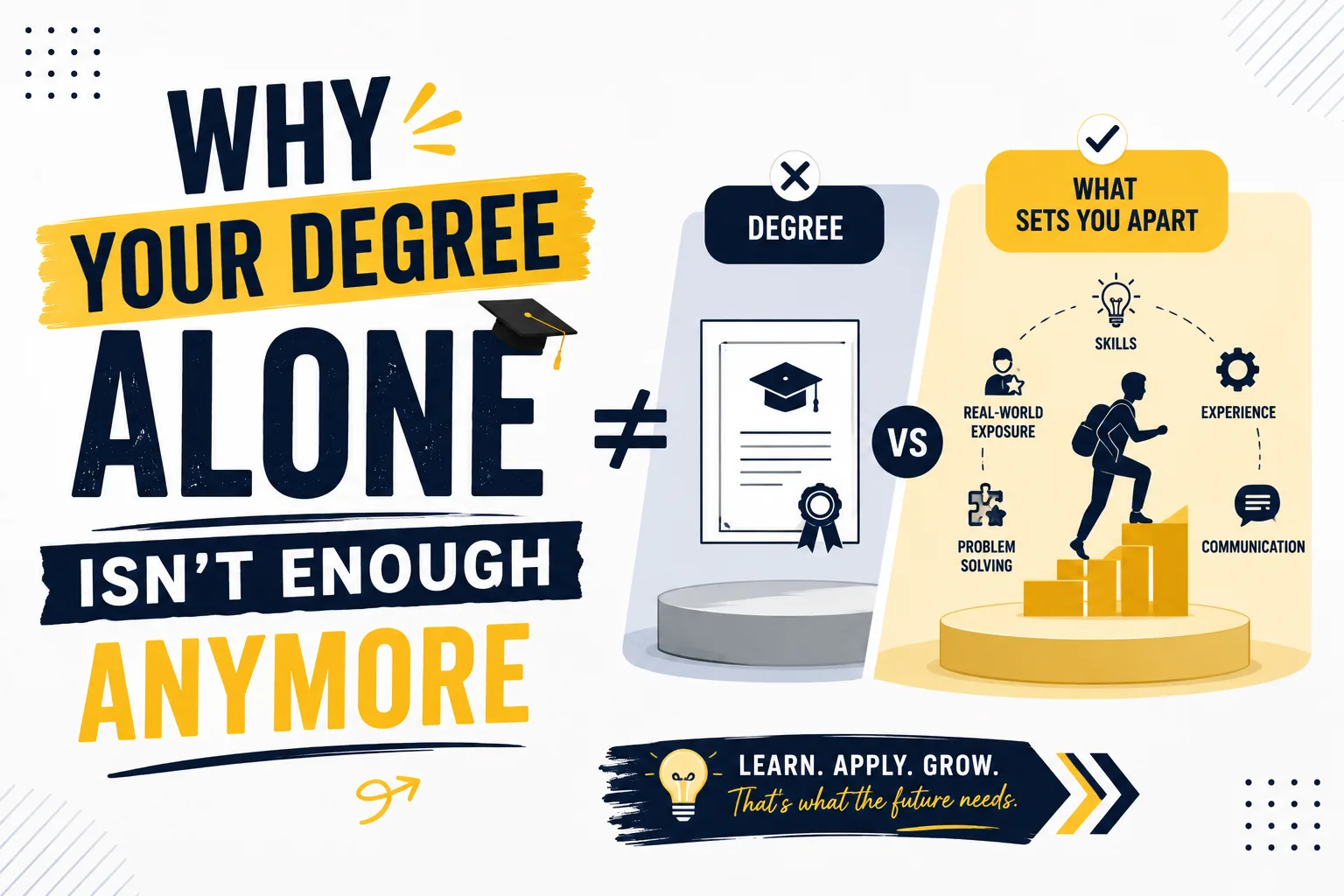
A degree can give you a strong foundation, but your ability to continue learning may determine how successfully you build on that foundation.
That is what lifelong learning is really about—not constantly collecting qualifications, but continuously improving your knowledge and abilities as your career evolves.
What Does Lifelong Learning Actually Mean?
Lifelong learning is the habit of continuing to develop knowledge and skills throughout your personal and professional life.
It doesn't necessarily mean returning to university every few years.
Learning can happen through:
Online courses
Workplace training
Books and industry reports
Professional certifications
Workshops
Conferences
Mentorship
Projects
Podcasts and lectures
Learning from colleagues
Experimenting with new tools
Sometimes lifelong learning is highly structured. Other times, it simply means being curious enough to investigate something you don't understand.
The important part is that learning becomes an ongoing process rather than something that ends at graduation.
1. Technology Keeps Changing the Skills Employers Need
Think about how many professions have changed because of technology.
Marketing professionals now work with analytics platforms, automation and AI-assisted tools.
Finance professionals increasingly interact with data platforms and financial technologies.
Designers use increasingly sophisticated digital tools.
Software professionals continuously encounter new frameworks, platforms and development methods.
Even professions that aren't traditionally considered “technical” increasingly involve digital systems.
This doesn't mean every professional needs to become a programmer.
It means most professionals need to understand how technology is changing their specific field.
Someone who stops learning risks becoming highly experienced in methods that organisations no longer prioritise.
2. AI Is Changing Jobs—Not Just Creating New Ones
Artificial intelligence has made lifelong learning even more important.
The conversation is often framed as:
“Which jobs will AI replace?”
But another useful question is:
“How will AI change the job I already want?”
A marketer may use AI to accelerate research and content workflows.
A programmer may use AI-assisted development tools.
An analyst may use AI to explore information faster.
A designer may incorporate generative tools into early ideation.
The important skill is not simply knowing that AI exists. It is understanding where it can improve productivity, where human judgement remains necessary and how to evaluate its outputs critically.
Students entering the workforce should expect tools to keep changing throughout their careers.
Learning how to learn may therefore become more valuable than mastering any single tool.
3. Your Degree Cannot Teach Everything You'll Need
A university curriculum has limited time.
It must teach foundational concepts, theories and skills. Industry, meanwhile, can change much faster.
By the time you graduate, employers may be using tools or processes that were not central to your syllabus.
This doesn't make formal education irrelevant.
A strong academic foundation helps you understand new concepts more effectively.
But students should avoid assuming:
“I completed my degree, so now I'm fully prepared for the next 30 years.”
Your degree is the foundation.
Your career is what you continue building on top of it.
4. Some of Tomorrow's Jobs May Look Very Different
Think about job titles that have become increasingly visible over the past decade:
Data scientist
Cloud engineer
UX researcher
AI engineer
Growth marketer
Sustainability specialist
Product manager
Cybersecurity analyst
Some roles existed earlier but became much more important. Others evolved alongside new technologies and business models.
The same will happen in the future.
Students currently in college may eventually work in roles that are still developing today.
That means career preparation shouldn't focus only on memorising what today's jobs require.
Students also need transferable abilities such as:
Problem-solving, communication, adaptability, critical thinking and learning agility.
These skills remain useful even when specific tools change.
5. Lifelong Learning Improves Career Adaptability
Careers rarely follow one straight path anymore.
Someone may begin in engineering and move into product management.
A finance professional may transition into analytics.
A marketer may specialise in growth strategy.
A designer may move toward user research.
Sometimes these transitions happen by choice.
Other times, industries change and professionals need to adapt.
Continuous learners generally have more options because they are already accustomed to developing new capabilities.
Instead of thinking:
“I've never done this before.”
they are more likely to ask:
“What would I need to learn to do this?”
That mindset creates flexibility.
6. It Can Help You Stay Competitive
Imagine two professionals with similar qualifications and experience.
One continues using the same methods for several years.
The other regularly learns new tools, understands industry developments and improves relevant skills.
Over time, their capabilities may become very different.
Experience matters, but experience combined with continuous improvement can be significantly more valuable.
Employers often value professionals who can adapt when processes, technologies or customer expectations change.
7. Learning Can Open New Career Opportunities
Sometimes learning a new skill doesn't simply make you better at your existing job.
It creates an entirely new direction.
A marketing professional who develops strong analytics skills may move toward marketing analytics.
A developer who learns business strategy may eventually explore product management.
A commerce graduate who develops data skills may pursue business analytics.
Careers increasingly sit at the intersection of multiple disciplines.
Continuous learning allows professionals to create combinations of skills that can differentiate them from others.
8. Lifelong Learning Builds Confidence
Career confidence doesn't come from knowing everything.
Nobody does.
A more sustainable form of confidence comes from knowing:
“If I don't understand something, I can learn it.”
That becomes especially valuable when starting a new job.
Every workplace has unfamiliar systems, terminology, expectations and processes.
Professionals who are comfortable learning tend to adapt more effectively because unfamiliarity doesn't automatically feel like failure.
They treat it as temporary.
9. Learning Helps Prevent Career Stagnation
It is possible to have many years of experience without continuously developing.
Someone can repeat essentially the same year of work multiple times.
Lifelong learning helps prevent this.
You might deepen your expertise.
Learn leadership.
Understand another business function.
Improve communication.
Develop technical capabilities.
Study emerging trends.
Each new layer can expand the kind of responsibilities you're capable of handling.
Career growth isn't always about getting promoted quickly.
Sometimes it means becoming significantly more capable than you were a year ago.
10. Soft Skills Need Continuous Development Too
Upskilling isn't only about technology.
As professionals move into larger responsibilities, human skills often become even more important.
These include:
Communication
Leadership
Negotiation
Decision-making
Conflict management
Presentation
Emotional intelligence
Team management
A technically strong employee may eventually need to manage people.
A great analyst may need to present findings to senior leadership.
A developer may need to explain technical decisions to non-technical stakeholders.
Career growth often requires learning beyond your original specialisation.
11. Lifelong Learning Doesn't Mean Collecting Certificates
This distinction matters.
It is easy to confuse:
Learning
with
Completing courses.
They aren't necessarily the same.
You can complete ten certifications and still struggle to apply what you studied.
A better approach is:
Learn → Apply → Reflect → Improve
If you learn Excel, use it on real data.
If you learn coding, build something.
If you study marketing, analyse a campaign.
If you learn public speaking, actually present.
Practical application helps turn information into ability.
Certificates can support your profile, but capability should remain the objective.
12. Learn Deeply Instead of Chasing Every Trend
Continuous learning doesn't mean learning everything.
That would be impossible.
Every week, a new tool, course or “must-have skill” appears online.
Trying to follow all of them creates distraction rather than progress.
Ask three questions before investing significant time in a new skill:
Is this relevant to my current or target career?
Will I actually use it?
Does it build on skills I already have?
If the answer is yes, it may deserve attention.
Being selective is part of effective lifelong learning.
13. Build a T-Shaped Skill Profile
A useful career-development model is the T-shaped professional.
The vertical part of the “T” represents deep expertise in one area.
The horizontal part represents broader supporting abilities.
For example, a data analyst might develop deep knowledge of analytics while also understanding:
Business
Communication
Data visualisation
AI tools
Presentation
Basic programming
This combination helps professionals become specialists without becoming isolated from the wider business environment.
14. Create a Simple Learning System
You don't need to study for several hours every day.
Consistency matters more.
A simple system might look like:
Weekly: Read one useful industry article or practise a skill.
Monthly: Complete a small practical project or explore one important topic deeply.
Every few months: Review how your industry and target roles are changing.
Annually: Identify one or two major capabilities you want to develop.
This makes continuous learning manageable rather than overwhelming.
15. Your Workplace Can Become a Classroom
Some of the most valuable professional learning happens while working.
Pay attention to:
How experienced colleagues solve problems.
How managers communicate.
How clients make decisions.
How teams handle mistakes.
How projects are organised.
Ask thoughtful questions.
Request feedback.
Volunteer for responsibilities that stretch your abilities when appropriate.
A job doesn't only pay you.
It can also teach you—if you're paying attention.
What Should Students Start Learning During College?
Students don't need to predict every future skill.
Instead, build a strong base.
Area
What to Develop
Core knowledge
Strong understanding of your field
Communication
Writing, speaking and presentation
Digital skills
Tools relevant to your profession
AI literacy
Understanding responsible and effective AI use
Problem-solving
Applying knowledge to unfamiliar situations
Practical exposure
Projects and internships
Learning ability
Finding, understanding and applying new information
Professional awareness
Understanding how your industry is changing
This foundation makes future learning easier.
Avoid the Pressure to Learn Everything
Students can easily become overwhelmed.
One person says learn coding.
Another says learn AI.
Someone says learn finance.
Then digital marketing.
Then data analytics.
Then communication.
Then entrepreneurship.
You don't need all of them.
Start with your career direction.
If you want to become a financial analyst, your learning priorities should look different from those of a graphic designer.
If you're unsure about your career, explore several areas briefly before choosing where to go deeper.
Learning should create clarity—not constant anxiety.
Staying Relevant in a Career That Keeps Changing
The idea of completing your education and then relying on the same knowledge throughout your entire career is becoming increasingly unrealistic.
But that doesn't have to be frightening.
It can also be an advantage.
If industries change, new opportunities appear.
If technologies evolve, new skills become valuable.
If careers become more flexible, you have more opportunities to redesign your professional direction.
The people best positioned for that environment won't necessarily be those who know the most today.
They will often be the people who remain willing and able to learn tomorrow.
Your degree can begin your career.
Your first job can build experience.
But curiosity, adaptability and continuous learning can help you remain valuable throughout decades of change.