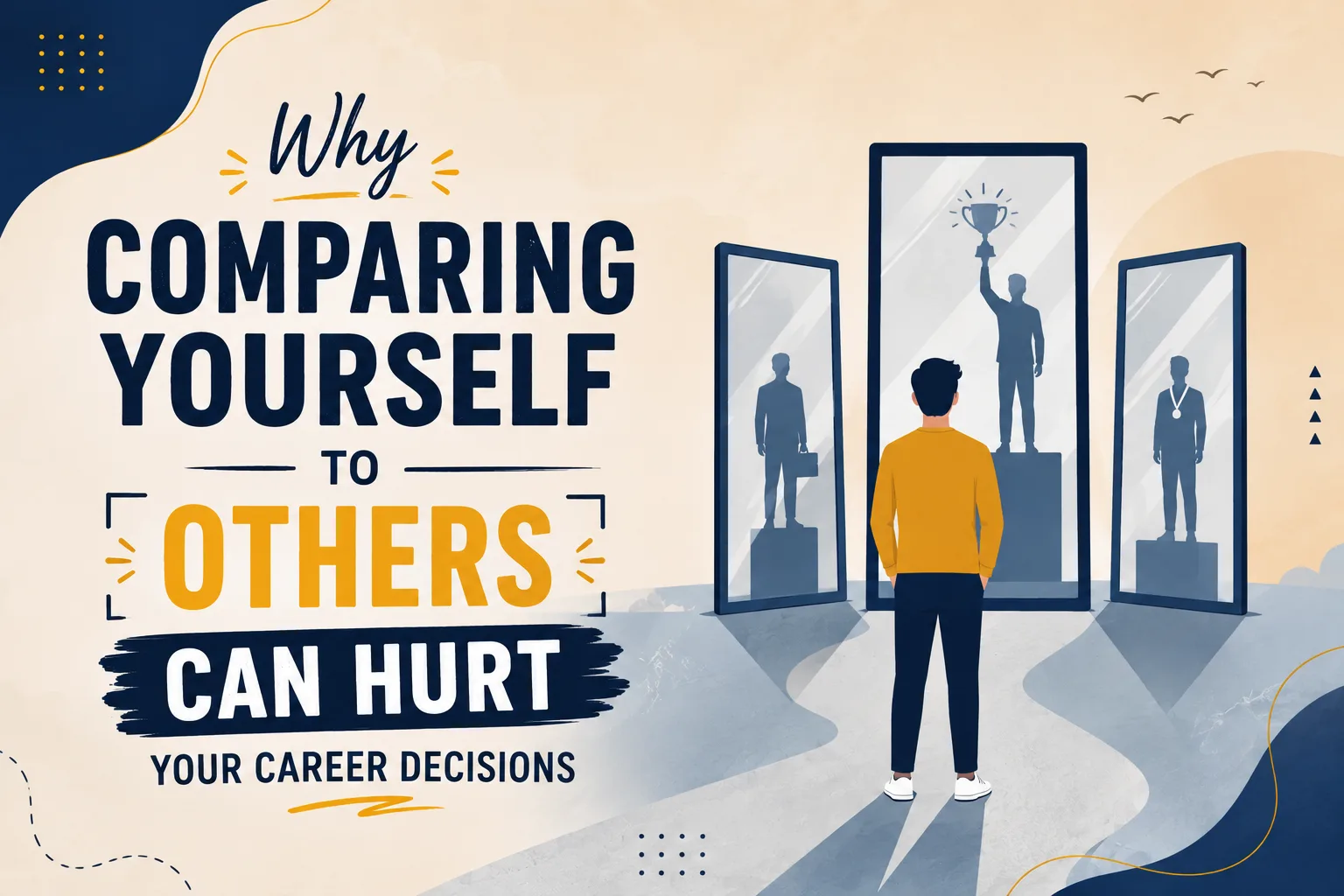
Why Comparing Yourself to Others Can Hurt Your Career Decisions
Someone got a better internship. Someone chose a higher-paying career. Someone already seems to have their future figured out. Constant comparison can make students question perfectly reasonable career choices. Here’s how to separate other people’s progress from the decisions that are right for you.
✍️ Kollege Next Editorial Team📅 13 Aug 2026📁 Student Guide
Your friend gets into a better-ranked college.
Someone from your class lands an internship at a famous company.
A senior announces a high-paying placement.
Another person your age appears to be running a successful startup.
You open social media and suddenly feel as though everyone is moving faster than you.
Then the questions begin:
“Am I falling behind?”
“Did I choose the wrong course?”
“Should I switch careers?”
“Why am I not doing as well as them?”
Comparison is natural. Seeing what others achieve can sometimes motivate us, expose us to new possibilities and help us set higher standards.
The problem begins when someone else's journey becomes the benchmark for your own decisions.
Career choices should be based on your interests, abilities, circumstances, priorities and long-term goals. When comparison takes over, students can end up chasing careers they never genuinely wanted.
1. You Rarely See the Complete Story
You usually see the result.
You don't always see what happened before it.
Someone posts:
“Excited to join XYZ Company!”
You see the achievement.
You may not see the 40 applications that received no response, the interviews they failed or the months they spent preparing.
The same applies to college admissions, competitive exams, internships and entrepreneurship.
People naturally share milestones more often than struggles.
Comparing your complete life with someone else's visible highlights creates an unfair comparison from the beginning.
2. Everyone Starts From a Different Position
Two students can be the same age and still have completely different circumstances.
One may have access to experienced mentors.
Another may need to work while studying.
One may already know professionals in their target industry.
Another may be the first person in their family exploring that profession.
Students may also differ in:
Financial resources
Academic background
Family responsibilities
Location
Professional exposure
Personal strengths
Career interests
Opportunities available
This doesn't mean circumstances permanently determine success.
It means comparing outcomes without considering starting points provides very little useful information.
3. Comparison Can Make You Chase the Wrong Career
Imagine your friend receives an impressive software engineering offer.
Suddenly, you start wondering whether you should learn coding too—even though you genuinely enjoy finance.
Or someone enters investment banking and earns more than you expected.
Now your interest in design begins to feel like a bad decision.
This is where comparison becomes dangerous.
Instead of asking:
“Which career fits me?”
you start asking:
“Which career makes me look successful compared with them?”
Those are completely different questions.
A career can look impressive from the outside and still be completely wrong for your interests, personality or preferred lifestyle.
4. Salary Comparison Can Distort Career Decisions
Salary is one of the easiest numbers to compare.
₹6 lakh.
₹12 lakh.
₹25 lakh.
One number looks clearly better than another.
But compensation alone doesn't tell you:
Working hours
Location
Role responsibilities
Job stability
Growth potential
Cost of living
Benefits
Work pressure
Required experience
Career satisfaction
A person earning more than you today isn't automatically building a better long-term career.
Early-career salaries can also change significantly as people develop skills, switch industries or take on larger responsibilities.
Use salary as one factor in a career decision—not as a scoreboard for your life.
5. You May Start Choosing Prestige Over Fit
Comparison often pushes students toward impressive labels.
A famous college.
A prestigious degree.
A well-known company.
A trendy job title.
There is nothing wrong with wanting any of these.
The problem is choosing them primarily because you want other people to be impressed.
A lesser-known college with the right course, manageable fees and strong opportunities may be a better fit than a prestigious institution where the programme doesn't suit your goals.
Similarly, a job at a smaller organisation may offer stronger learning and responsibility than a famous company where your role is extremely limited.
Prestige can be valuable.
But prestige without personal fit can become expensive dissatisfaction.
6. Social Media Makes Comparison Constant
Earlier generations mainly compared themselves with classmates, relatives or colleagues.
Students today can compare themselves with thousands of people every day.
Professional platforms show promotions, internships, awards and job announcements.
Social platforms show travel, lifestyles, college experiences and entrepreneurship.
What they rarely show with equal frequency are:
Rejections.
Confusion.
Financial problems.
Failed projects.
Career changes.
Average days.
This can create the illusion that extraordinary achievement is normal and that ordinary progress means you're falling behind.
Remember:
Visibility is not the same as reality.
7. Comparison Can Make You Ignore Your Own Progress
Suppose six months ago you couldn't confidently give a presentation.
Today you can.
You completed your first project.
Improved your grades.
Learned Excel.
Started coding.
Applied for internships.
Built a portfolio.
Those are meaningful improvements.
But if you're constantly watching someone five steps ahead, your own progress may feel insignificant.
A better comparison is:
“Am I better prepared than I was six months ago?”
That question produces useful information.
8. It Can Push You Into Unnecessary Courses and Certifications
Students often see someone posting:
“Completed another certification!”
Then suddenly feel they should enrol too.
Soon, they have five unfinished online courses and no clear reason for completing any of them.
Before starting a course, ask:
Does this skill matter for the career I'm considering?
Will I actually use it?
Can I demonstrate what I've learned?
One relevant skill developed deeply can be more useful than several certificates collected because everyone else appears to have them.
9. Comparison Creates Artificial Career Timelines
Students often imagine careers should follow a fixed schedule:
21: Graduate 22: First job 24: Promotion 26: High salary 28: Leadership position
Real careers rarely follow such neat timelines.
Someone may discover their field early.
Someone else may change careers at 25.
Another person may pursue higher education.
Someone may take longer to find the right opportunity and then progress quickly.
Career development is not a race where everyone starts at the same point and must cross identical milestones at the same age.
Different paths can still lead to successful outcomes.
10. You Become Afraid to Take a Different Path
Comparison encourages conformity.
If everyone around you is preparing for engineering, choosing design feels risky.
If your classmates are preparing for placements, starting a business feels uncertain.
If your friends want an MBA, pursuing a specialised master's degree may feel unusual.
But some of the best career decisions require choosing a path that isn't popular within your immediate circle.
Different does not automatically mean better.
But different doesn't automatically mean wrong either.
Your responsibility is to evaluate the path intelligently.
11. Comparison Can Damage Confidence
Repeated comparison can gradually change how you see yourself.
Instead of:
“They're doing well.”
it becomes:
“They're doing well, therefore I'm failing.”
Those statements are not logically connected.
Another person's achievement doesn't reduce your abilities or opportunities.
When confidence drops, students may stop applying for competitive internships, avoid interviews or reject opportunities because they assume everyone else is more qualified.
Comparison can therefore become self-reinforcing: you feel behind, take fewer chances and then fall further behind because you stopped participating.
12. Career Decisions Require Self-Awareness, Not Imitation
Good career planning begins with understanding yourself.
Ask:
What type of problems do I enjoy solving?
Which subjects genuinely interest me?
What skills am I willing to develop seriously?
Do I enjoy working with people, numbers, ideas or technology?
What kind of working environment suits me?
How important are income, flexibility, stability and creativity to me?
The answers may be completely different from your friend's.
That's exactly why copying their career path makes little sense.
13. Healthy Comparison Can Still Be Useful
Not all comparison is harmful.
Someone else's progress can provide useful information.
If a senior secured an internship you want, instead of thinking:
“They're so far ahead of me.”
ask:
“What did they do that I can learn from?”
Maybe they built relevant projects.
Improved their communication.
Applied earlier.
Created a better portfolio.
Practised interviews consistently.
Now comparison has become research rather than judgement.
That's useful.
The goal isn't to stop noticing other people's success.
It's to extract lessons without turning their achievements into evidence against yourself.
14. Build Your Own Career Scorecard
Instead of measuring your career against classmates, create personal indicators.
For example:
Area
Question
Skills
Am I improving skills relevant to my target career?
Academics
Am I maintaining the performance I need?
Experience
Am I gaining meaningful practical exposure?
Communication
Can I explain my ideas more clearly?
Network
Am I building useful professional relationships?
Career clarity
Do I understand my options better than before?
Portfolio
Can I demonstrate what I've learned?
Review these every few months.
This turns career progress into something you can actually manage.
15. Separate Inspiration From Pressure
When you see someone succeeding, notice your reaction.
If you think:
“That's interesting. I want to learn how they did it.”
That's inspiration.
If you think:
“They're ahead, so I need to change what I'm doing immediately.”
That's pressure.
The difference matters.
Inspiration encourages learning.
Pressure encourages impulsive decisions.
Before changing your career plan because of someone else's success, give yourself time to investigate whether you genuinely want the same outcome.
Ask Better Questions
Instead of:
“Why are they ahead of me?”
Ask:
“What can I learn from their approach?”
Instead of:
“Why is their salary higher?”
Ask:
“What skills create long-term value in my field?”
Instead of:
“Should I choose their career?”
Ask:
“Would I actually enjoy the daily work involved?”
Instead of:
“Am I successful yet?”
Ask:
“Am I moving in a direction that makes sense for me?”
Better questions create better career decisions.
Build a Career That Fits You
There will always be someone with a better package, higher CGPA, bigger internship, more impressive college or faster promotion.
If your definition of success depends on staying ahead of everyone else, satisfaction will always remain temporary.
Career planning becomes healthier when you replace comparison with self-awareness and evidence.
Learn from people who are doing well.
Study their strategies.
Use their journeys as information.
But don't automatically adopt their goals.
Your career needs to work with your strengths, interests, financial circumstances, preferred lifestyle and definition of success.
The objective isn't to build a career that looks better than someone else's.
It is to build one that still makes sense when nobody else is watching.