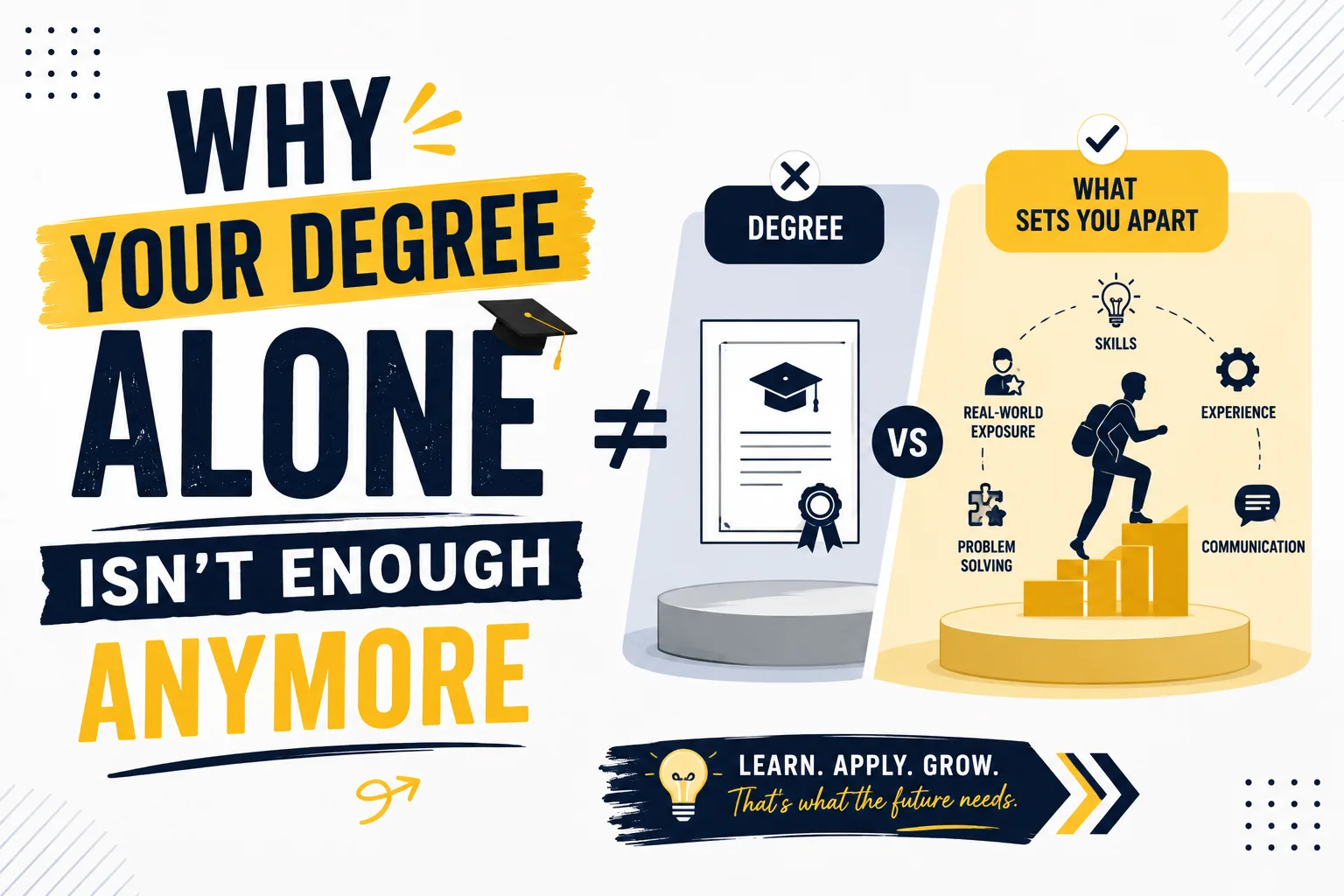
A college degree remains valuable, but simply graduating is no longer enough to stand out in a competitive job market. Employers increasingly look for practical skills, experience, communication and evidence that you can apply what you've learned.
✍️ Kollege Next Editorial Team📅 12 Aug 2026📁 Student Guide
For years, the career formula seemed straightforward:
Get good marks → Earn a degree → Find a good job → Build a career.
That path hasn't disappeared, but it has changed.
Today, millions of students graduate with similar qualifications. A degree may help you meet the basic eligibility criteria for a role, but employers often need another answer:
What can you actually do?
Can you communicate clearly? Can you solve unfamiliar problems? Have you worked on real projects? Can you use the tools required in your industry? Can you collaborate with a team? Can you adapt when technology changes?
This doesn't mean degrees have become useless. Far from it.
Degrees still provide academic foundations, structured learning, credentials and access to professions where formal qualifications are essential. But in many careers, a degree has increasingly become the starting point rather than the complete career package.
Here is why students need to think beyond their qualification.
1. More Graduates Means More Competition
A degree once helped candidates differentiate themselves simply because fewer people had one.
Today, recruiters may receive applications from hundreds or thousands of graduates with similar academic backgrounds.
Imagine two candidates applying for the same entry-level position.
Both have a B.Tech degree.
Both have similar CGPAs.
But one has also completed an internship, built two practical projects, understands industry tools and can clearly explain their work.
Who gives the recruiter more evidence of job readiness?
The degree gets both candidates into the conversation.
What they have done beyond the degree may separate them.
2. Employers Hire Skills, Not Just Qualifications
Companies don't hire someone simply because they studied marketing, computer science, finance or design.
They hire people to perform specific responsibilities.
A data analyst may need to work with spreadsheets, SQL, dashboards and business data.
A digital marketer may need campaign management, analytics, content and research skills.
A software developer needs to solve programming problems and build reliable applications.
A designer needs to demonstrate visual and problem-solving ability through a portfolio.
Your qualification tells employers what you studied.
Your skills help demonstrate what you can contribute.
3. Academic Knowledge and Workplace Application Are Different
Knowing a concept and applying it under real conditions aren't always the same thing.
A student may understand marketing theory but struggle to analyse an actual campaign.
Someone may know programming syntax but find it difficult to build a complete application.
A finance student may understand ratios academically but have limited experience interpreting real company information.
That's why practical exposure matters.
Projects, case studies, internships, simulations, research and competitions help students move from:
“I know this concept.”
to
“I have used this concept to solve something.”
That second statement is far more powerful during recruitment.
4. Technology Is Changing Faster Than Many Curricula
Industries can change rapidly.
Artificial intelligence, automation, cloud platforms, analytics and new digital tools are transforming how organisations operate.
College curricula provide essential foundations, but they cannot always update at the same speed as industry.
Students therefore need to develop the habit of learning independently.
Depending on your field, that could involve:
New software
Industry tools
Programming languages
AI-assisted workflows
Data platforms
Design tools
Digital marketing platforms
Financial technology
The goal isn't to chase every new trend.
It is to develop enough curiosity and adaptability that your knowledge doesn't stop growing when the semester ends.
5. Internships Provide Evidence That You Can Work
An internship gives employers something academic marks alone cannot provide: evidence that you have experienced a professional environment.
During an internship, students learn about:
Deadlines
Meetings
Feedback
Team communication
Workplace expectations
Professional responsibility
Real-world problem-solving
Even a short but meaningful internship can help students understand how organisations function.
More importantly, it gives you genuine experiences to discuss during interviews.
Instead of simply claiming:
“I have good teamwork skills.”
you can explain how you collaborated with colleagues to complete an actual project.
Evidence is stronger than adjectives.
6. Projects Can Be More Powerful Than Certificates
Students sometimes collect online certificates believing each one automatically strengthens their resume.
Certificates can demonstrate learning, but employers may want to see whether you can apply that knowledge.
If you complete a Python course, build something using Python.
If you learn data analytics, create a dashboard from a real dataset.
If you're studying marketing, analyse a campaign or create a strategy for a real or hypothetical business.
If you're learning design, build a portfolio.
A useful principle is:
Learn → Apply → Build → Explain.
The project shows application.
The interview shows whether you truly understand it.
7. Communication Can Decide Whether Your Skills Get Noticed
You may be technically excellent, but professional environments still require communication.
You need to explain your ideas.
Write emails.
Present findings.
Participate in meetings.
Understand instructions.
Ask questions.
Work with people who may not share your technical background.
This is why communication skills matter across engineering, management, healthcare, design, law and almost every other profession.
You don't need complicated vocabulary.
You need to communicate your thoughts clearly, confidently and appropriately.
8. Employers Value Problem-Solvers
College examinations often provide clearly defined questions.
Workplace problems rarely arrive that neatly.
A manager may simply say:
“Customer retention is falling. Find out why.”
Now you have to determine what information matters, identify possible causes, analyse evidence and recommend a solution.
That requires more than memorisation.
Students can develop problem-solving ability through:
Case competitions
Hackathons
Research
Live projects
Internships
Entrepreneurship
Practical assignments
Learning how to approach an unfamiliar problem can become one of your most transferable career skills.
9. Your Portfolio Can Say More Than Your Resume
In many fields, showing your work is becoming increasingly valuable.
A portfolio could contain:
For developers: GitHub projects, applications or websites.
For designers: UI/UX projects, branding work or illustrations.
For writers: Articles, reports or published content.
For marketers: Campaign ideas, content strategies or analytics projects.
For data students: Dashboards, analyses or machine-learning projects.
For architects: Design projects and visual work.
Your portfolio answers a powerful question:
“What have you actually created?”
That can make your profile much more credible.
10. Networking Creates Opportunities You May Never Find Online
Not every career opportunity begins on a job portal.
Sometimes it begins with:
A professor recommending you.
An alumnus telling you about an internship.
A professional you met at an event sharing an opening.
A former internship manager contacting you.
A classmate introducing you to a startup.
Networking isn't about asking strangers for jobs.
It is about developing genuine professional relationships.
College gives you access to professors, alumni, student communities, recruiters, guest speakers and peers. Ignoring those connections means overlooking an important part of career development.
11. Soft Skills Can Become Your Competitive Advantage
Technical knowledge helps you perform tasks.
Soft skills influence how effectively you work with others.
Employers value qualities such as:
Teamwork
Adaptability
Leadership
Time management
Emotional intelligence
Professionalism
Critical thinking
Communication
These abilities are particularly important when several candidates have similar academic qualifications.
Your CGPA may demonstrate academic discipline.
Your behaviour during a group discussion, internship or interview shows how you operate around people.
Both matter.
12. Your First Job May Not Match Your Degree Exactly
Career paths are becoming increasingly flexible.
An engineering graduate may move into consulting.
A commerce graduate may enter data analytics.
A computer science graduate may eventually work in product management.
A humanities graduate may build a career in marketing, policy, research or human resources.
This makes transferable skills extremely important.
Instead of thinking only:
“What jobs can I get with this degree?”
also ask:
“What skills am I building that can be useful across different careers?”
That creates more options.
13. AI Makes Adaptability Even More Important
AI tools are increasingly capable of assisting with writing, coding, research, design, analysis and administrative work.
For students, the wrong response is either extreme:
“AI will replace everyone.”
or
“AI won't affect my career.”
A better response is learning how technology is changing your field.
Understand which routine tasks can be automated, where human judgement remains important and how AI tools can improve your productivity.
Students who combine domain knowledge with technology literacy, critical thinking and communication may be better positioned than those who simply ignore technological change.
14. Your Online Professional Presence Matters
Recruiters and professional contacts may encounter you online before ever meeting you.
That makes your digital presence another part of your career profile.
Depending on your profession, consider maintaining:
An updated professional networking profile
A portfolio
GitHub
Published articles
Project demonstrations
Relevant professional activity
You don't need to become a content creator.
Simply make it easy for someone interested in your work to understand your education, skills, projects and interests.
15. Continuous Learning Doesn't End at Graduation
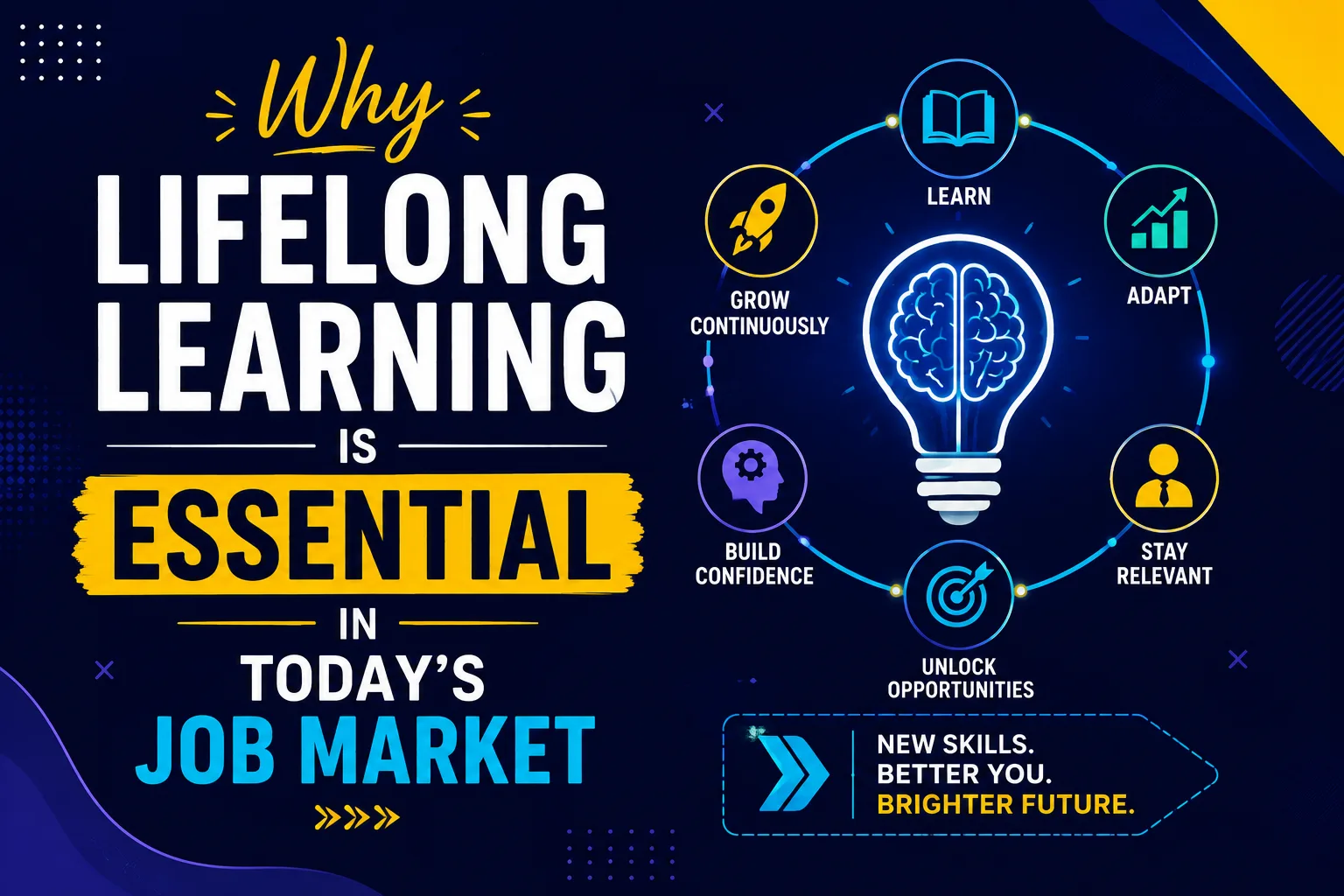
One of the biggest mindset shifts students can make is recognising that education doesn't finish when the degree certificate arrives.
Industries change.
Tools change.
Job roles change.
Your responsibilities change.
Professionals who remain curious and continue learning can adapt more easily.
This doesn't mean constantly purchasing courses.
Continuous learning can include:
Reading industry reports
Working on projects
Learning from colleagues
Attending workshops
Following credible industry sources
Taking specialised courses when necessary
Experimenting with new tools
Your degree may begin your professional education.
Your career continues it.
So, Does Your Degree Still Matter?
Absolutely.
A degree can provide:
Structured education
Academic foundations
Credibility
Peer networks
Faculty guidance
Campus opportunities
Internship access
Placement opportunities
Eligibility for further education
And in professions such as medicine, law, architecture and several regulated fields, specific educational qualifications can be essential.
The message isn't:
“Degrees don't matter.”
The better message is:
“A degree works best when you build on top of it.”
The Career Stack Every Student Should Build
Think of your career preparation as several layers.
Layer
What It Provides
Degree
Academic foundation
Skills
Ability to perform
Projects
Evidence of application
Internships
Workplace exposure
Soft skills
Ability to work effectively with people
Network
Professional relationships
Portfolio
Proof of your capabilities
Continuous learning
Ability to stay relevant
The strongest graduate profile combines several of these rather than depending entirely on one.
What Should You Do During College?
You don't need to do everything at once.
First Year
Explore different interests, participate in student activities and build basic communication and digital skills.
Second Year
Develop skills related to your preferred career areas and start building practical projects.
Third Year
Pursue meaningful internships, strengthen your portfolio and understand recruitment expectations.
Final Year
Focus on placements or higher education, refine your resume, practise interviews and use your existing experiences effectively.
The exact timeline will vary depending on whether your programme lasts three, four or more years.
What matters is consistent progress.
Don't Turn This Into Another Pressure Checklist
There is an important warning here.
Students sometimes hear that a degree isn't enough and respond by trying to collect everything:
Ten certifications.
Five internships.
Four clubs.
Three competitions.
A perfect CGPA.
A side hustle.
A personal brand.
That isn't the point.
Career readiness is about depth, not endless activity.
One strong internship can be better than five superficial ones.
Two meaningful projects can be more valuable than twenty certificates you cannot explain.
Choose experiences that genuinely develop your abilities.
Building a Career Beyond the Degree
Your degree remains an important part of your professional foundation—but it shouldn't be the only thing you graduate with.
Leave college with knowledge.
But also leave with experiences.
Build something.
Solve problems.
Complete an internship.
Learn how to communicate.
Work with different people.
Develop professional relationships.
Understand the technology affecting your field.
Most importantly, become comfortable learning things you were never formally taught.
The modern career question isn't simply:
“What degree do you have?”
Increasingly, it is:
“What can you do with what you've learned?”
Your degree can open the first door.
Your skills, experience, adaptability and ability to keep learning will help determine what happens after you walk through it.