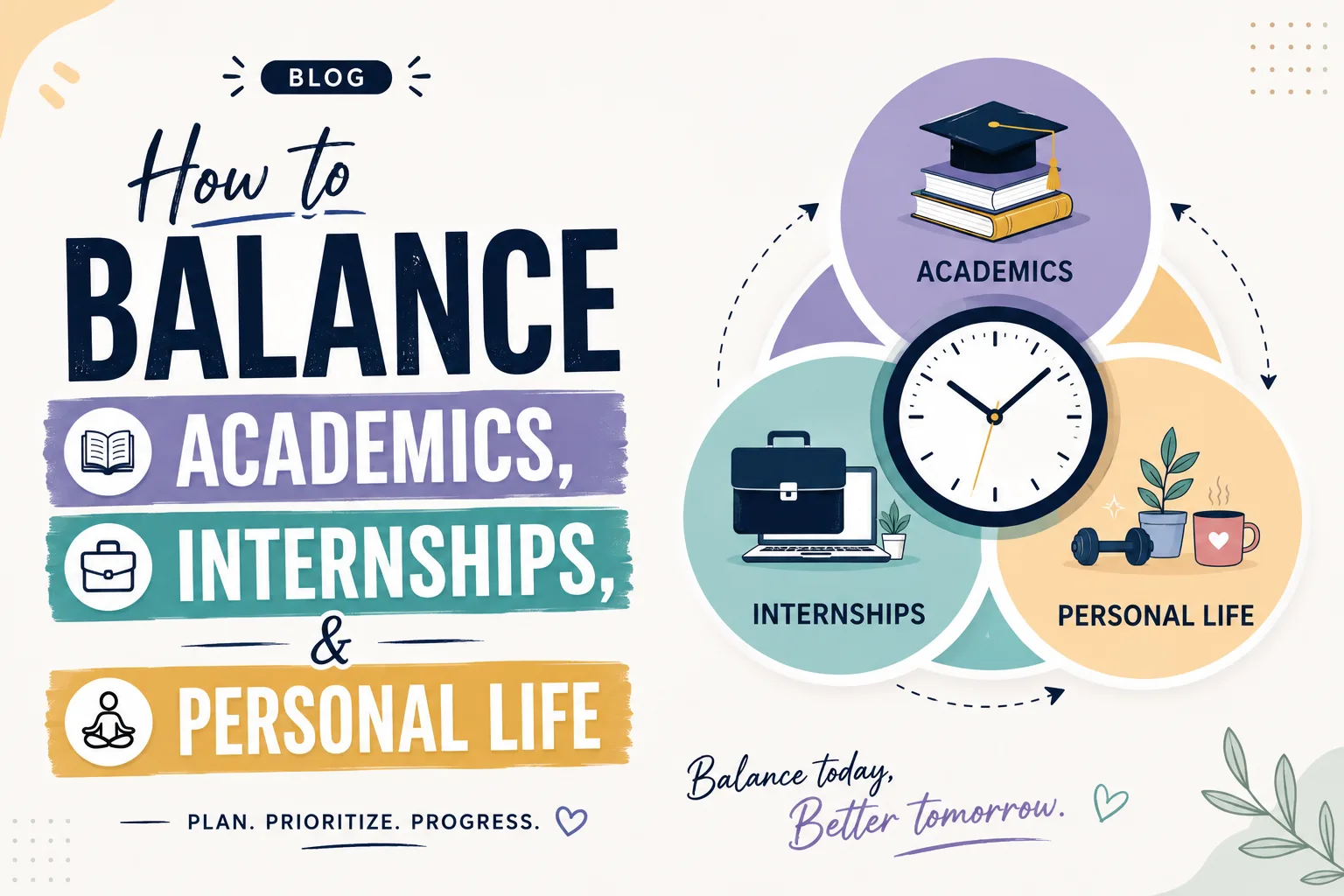
How to Balance Academics, Internships, and Personal Life Without Burning Out
College students are expected to maintain grades, gain practical experience, develop skills and still have a life outside academics. The answer isn't doing everything at once. It is learning how to prioritise, plan realistically and protect time for yourself.
✍️ Kollege Next Editorial Team📅 10 Aug 2026📁 Student Guide
College life can quickly become a juggling act.
You have lectures in the morning, an assignment due tomorrow, an internship meeting in the afternoon, an upcoming examination, a club event on the weekend—and somewhere between all of this, you're supposed to sleep, exercise, meet friends and have some time for yourself.
It can feel as though successful students somehow manage everything effortlessly.
They don't.
Balancing academics, internships and personal life isn't about fitting more activities into every available hour. It is about deciding what deserves your attention right now, what can wait and what isn't worth doing at all.
The goal isn't to create a perfectly balanced day. Some weeks will naturally be dominated by exams, while others may involve heavier internship responsibilities.
What matters is creating a routine you can actually sustain.
1. Accept That You Cannot Prioritise Everything
This is the first lesson—and probably the most important.
Students often try to maintain excellent grades, complete multiple certifications, join three clubs, work an internship, exercise every day, attend every social event and somehow remain productive throughout.
Eventually, something suffers.
Instead, decide on your major priorities for each semester.
For example:
Priority 1: Academics Priority 2: One meaningful internship Priority 3: Health and personal relationships
Everything else becomes optional.
Being busy and making progress are not the same thing.
2. Plan Your Week Before It Starts
Trying to remember every responsibility mentally creates unnecessary stress.
At the beginning of each week, list your fixed commitments:
Lectures
Labs
Internship hours
Assignment deadlines
Tests
Meetings
Personal commitments
Once those are visible, schedule focused blocks for studying, projects and revision.
Don't plan every minute. Leave some flexibility because college schedules frequently change.
A realistic weekly plan works better than an ambitious timetable you abandon after two days.
3. Use Your Academic Calendar Strategically
Not every week in college carries the same workload.
At the beginning of the semester, note important dates such as:
Mid-semester examinations
Final examinations
Project submissions
Practical assessments
Presentations
Major college events
Then communicate these periods to your internship supervisor early when possible.
If you know your examinations begin in three weeks, don't wait until the night before to explain that you cannot complete an internship task.
Planning ahead reduces conflicts between academics and professional commitments.
4. Choose Internships for Value, Not Just Certificates
Students sometimes accept every internship opportunity because they believe more certificates automatically create a stronger resume.
They don't.
One meaningful internship where you genuinely contribute can be more valuable than several superficial experiences.
Before accepting an internship, ask:
What will I actually learn?
How many hours will it require?
Are the responsibilities relevant to my career interests?
Can I realistically manage it alongside college?
If an internship consumes so much time that your academics, health and sleep consistently suffer, the trade-off may not be worthwhile.
5. Learn the Difference Between Urgent and Important
Not every task demanding attention is equally valuable.
Imagine you have:
An exam next week. An internship presentation tomorrow. A club meeting tonight. A certification course you haven't finished.
The presentation is urgent.
The exam is important.
The club meeting may be optional.
The certification can probably wait.
This simple distinction helps prevent students from spending their best hours on low-value activities while important responsibilities remain unfinished.
6. Stop Trying to Multitask
Watching a lecture while replying to internship messages and checking social media may feel productive.
Usually, it isn't.
Constantly switching between tasks reduces concentration and makes everything take longer.
Instead, create focused blocks.
For example:
4:00–5:30 PM: Assignment 5:30–6:00 PM: Break 6:00–7:00 PM: Internship work 7:00 onwards: Dinner and personal time
During each block, concentrate on one major activity.
You don't necessarily need more hours. You often need fewer distractions during the hours you already have.
7. Use Small Gaps Instead of Wasting Them
College schedules often contain awkward gaps between lectures.
Twenty minutes here.
Forty minutes there.
An hour before the next class.
These periods may not be suitable for deep studying, but they're useful for smaller tasks such as:
Reviewing notes
Replying to important emails
Organising assignments
Reading
Revising flashcards
Planning internship tasks
Completing smaller responsibilities during these gaps can free larger blocks later for focused work or personal time.
8. Protect Your Sleep
When schedules become crowded, sleep is usually the first thing students sacrifice.
An occasional late night before an important deadline may happen. Making it your normal routine is different.
Insufficient sleep can affect concentration, learning, mood and productivity—exactly the abilities you need to manage a demanding schedule.
If you're constantly working until 2 or 3 AM just to keep up, the problem may not be your discipline.
Your schedule may simply contain too many commitments.
Removing one responsibility can sometimes improve performance across everything else.
9. Schedule Personal Time Too
Personal time shouldn't be whatever remains after you've finished everything.
Because the work is never completely finished.
There will always be another assignment, internship task, exam or email.
Make room for things that help you recharge:
Exercise
Sports
Hobbies
Friends
Family
Music
Reading
Simply doing nothing for a while
Rest isn't wasted time.
A sustainable routine needs periods when you're not trying to improve your CGPA, resume or career.
Does this genuinely help one of my current priorities?
If the answer is no, declining may be the smarter choice.
A packed resume filled with shallow activities isn't necessarily stronger than a focused profile showing meaningful involvement and real skills.
11. Keep Academics Consistent
One reason students struggle during exam season is that they allow coursework to accumulate.
You don't need to study for five hours every day.
Instead, maintain small academic habits throughout the semester:
Review important concepts after lectures.
Complete assignments before the final deadline.
Clarify doubts early.
Keep notes organised.
Revise difficult topics periodically.
Consistent academic effort reduces the need for extreme study sessions immediately before examinations.
12. Set Boundaries With Your Internship
Internships provide valuable professional exposure, but students should still have reasonable boundaries.
If you're working remotely, it can become especially easy for internship tasks to enter every part of your day.
Where possible, establish expected working hours and understand deadlines clearly.
If a task conflicts with an important examination or academic requirement, communicate early and professionally rather than disappearing at the last moment.
Learning to manage expectations is itself an important workplace skill.
13. Don't Compare Your Schedule With Someone Else's
You may know someone who appears to be doing everything.
They have a high CGPA, internship, startup, gym routine, active social life and somehow post about all of it online.
You don't know their full situation.
They may have a lighter course load, different responsibilities, stronger support systems or simply be showing the best parts of their life.
Build a schedule around your capacity and priorities, not somebody else's highlight reel.
14. Watch for Signs You're Doing Too Much
Being temporarily tired during an intense week is normal.
Feeling permanently exhausted is different.
Your schedule may need adjustment if you consistently:
Struggle to concentrate
Miss deadlines
Lose interest in activities you previously enjoyed
Sleep poorly
Skip meals
Feel constantly overwhelmed
Stop spending time with people
Make avoidable mistakes
Don't automatically respond by creating an even stricter productivity routine.
Sometimes the correct solution is reducing your workload.
15. Review Your Routine Every Few Weeks
A schedule that worked in August may not work during examination season.
Every few weeks, ask:
What is taking most of my time?
Which activities are actually helping me?
What am I constantly postponing?
Am I sleeping and eating properly?
Is my internship still worth the time I'm investing?
Do I have any genuine free time?
Then adjust.
Balance isn't something you achieve once. It changes throughout the semester.
A Realistic Student Routine
There is no universal perfect schedule, but a normal weekday might look something like this:
Time
Activity
Morning
Classes / lectures
Afternoon
Classes + smaller academic tasks
Late afternoon
Internship work
Early evening
Exercise / break
Evening
Study or assignments
Night
Dinner + personal time
Before bed
Light planning for tomorrow
During examinations, internship hours may decrease.
During semester breaks, internships may receive more attention.
That flexibility is what real balance looks like.
Use the 3-Priority Rule
When everything feels overwhelming, simplify your day.
Choose only three important outcomes.
For example:
Academic: Complete tomorrow's assignment.
Career: Finish the internship presentation.
Personal: Exercise for 30 minutes.
Anything beyond those three is a bonus.
This prevents a 15-item to-do list from making an otherwise productive day feel unsuccessful.
Don't Turn College Into a Four-Year Resume-Building Exercise
Career preparation matters.
Internships matter.
Grades matter.
But college is also a period of independence, friendships, exploration and personal growth.
Not every activity needs to become a LinkedIn post.
Not every hobby needs to become a side hustle.
Not every weekend needs to be productive.
A strong career is important, but constantly preparing for your future shouldn't prevent you from experiencing your present.
Finding a Balance That Actually Works
Balancing academics, internships and personal life doesn't mean giving exactly one-third of your time to each.
Balance changes.
During examinations, academics may receive most of your attention. During vacations, internships can become the priority. Some weekends may be completely personal.
The important thing is that no single area continuously consumes everything else.
Plan your week, choose internships carefully, maintain consistent academic habits and protect enough time for sleep, health and relationships.
Most importantly, stop measuring productivity by how exhausted you feel.
College isn't about doing the maximum number of things possible.
It's about doing the right things well enough, for long enough, without losing yourself in the process.