How to Discover Your Interests Before Choosing a Career
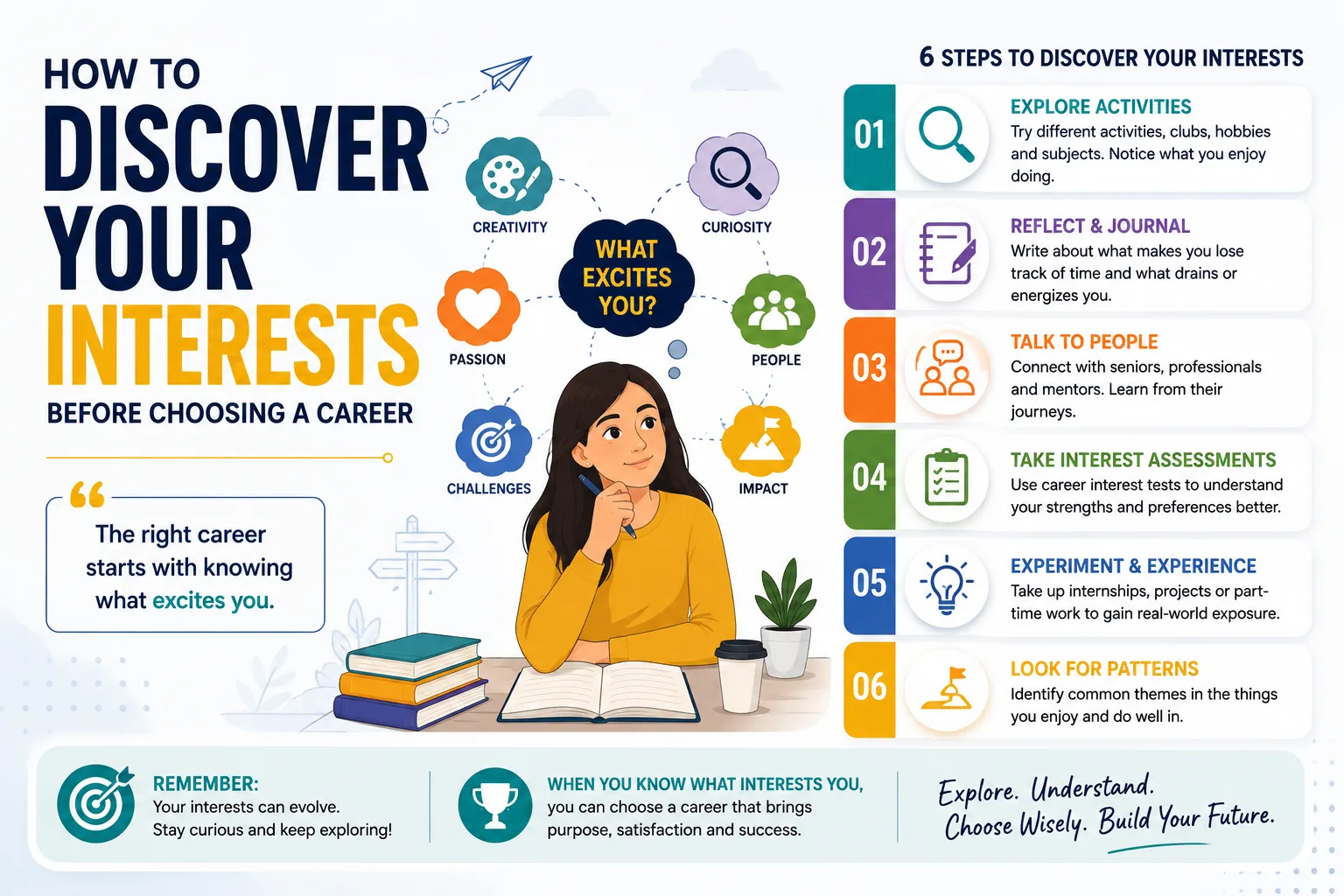
Choosing a career becomes easier when you understand what genuinely interests you. Instead of following trends, salaries or other people's choices, explore your strengths, experiences and preferences to find career paths that are worth investigating.
✍️ Kollege Next Editorial Team📅 07 Aug 2026📁 Student Guide
“What do you want to become?”
Students hear this question repeatedly during school. For some, the answer comes easily. For many others, it creates more confusion than clarity.
You may enjoy biology but not want to become a doctor. You might be good at mathematics but have no interest in engineering. Perhaps you enjoy designing presentations, organising events, analysing numbers, writing, coding or helping people—but you don't know which careers connect with those interests.
That is completely normal. Career clarity rarely appears suddenly. It usually develops through exploration, experience and self-awareness.
Instead of forcing yourself to choose one lifelong career immediately, a better starting point is understanding what kind of problems, activities and environments naturally hold your attention.
Start With What You Actually Enjoy Doing
Interests are often hidden inside everyday activities.
Think about what you voluntarily spend time doing when nobody is asking you to do it.
Maybe you enjoy:
Solving puzzles or numerical problems
Editing videos
Drawing or designing
Reading about technology
Organising events
Helping friends understand concepts
Following businesses and startups
Writing stories or articles
Experimenting with computers
Learning about human behaviour
Don't immediately ask whether an activity can become a career. First identify the pattern.
Someone who enjoys organising events may be interested in management, operations, hospitality or marketing. Someone fascinated by why people behave differently may eventually explore psychology, behavioural science, marketing or human resources.
Your interests provide clues—not final answers.
Separate Interest From Ability
Being good at something and enjoying it are not always the same.
You might score well in mathematics because you have practised extensively but find it exhausting. Alternatively, you might love photography even though your current technical skills are basic.
Ask yourself two separate questions:
What am I good at?
and
What do I enjoy enough to become better at?
The strongest career possibilities often appear where interest and ability overlap.
However, don't reject something simply because you're currently inexperienced. Skills can be developed.
Notice What Makes You Curious
Curiosity can reveal career interests more effectively than marks.
Look at the topics you naturally search for, videos you watch, articles you read or conversations that hold your attention.
For example, if you regularly explore:
Technology and gadgets: engineering, computer science, product management or electronics may be worth investigating.
Businesses and startups: management, finance, entrepreneurship or marketing could be relevant.
Health and the human body: medicine, physiotherapy, nutrition, pharmacy or allied healthcare may interest you.
Human behaviour: psychology, sociology, HR or behavioural economics could be possibilities.
Visual creativity: design, architecture, animation, UI/UX or advertising may deserve exploration.
Your browsing history shouldn't choose your career, but repeated curiosity can tell you where to investigate further.
Think About Problems You Enjoy Solving
Careers are ultimately about solving problems.
Instead of asking only, “Which subject do I like?”, ask:
What kinds of problems do I enjoy working on?
A student who likes solving logical problems may enjoy programming or analytics.
Someone who likes helping people through difficult situations may explore counselling, healthcare or social work.
A student who enjoys convincing people and presenting ideas may be comfortable in sales, marketing, consulting or law.
Someone who constantly finds ways to improve systems may enjoy operations, engineering or product management.
Thinking in terms of problems makes career exploration much more practical.
Explore Careers Before Selecting Them
Students often choose careers based on incomplete impressions.
“Law means arguing in court.”
“Computer Science means coding all day.”
“Marketing means making advertisements.”
“Psychology means counselling people.”
Real professions are usually much broader.
Before choosing a career, research what professionals actually do on an ordinary working day.
Find out about:
Typical responsibilities
Work environment
Required qualifications
Skills used regularly
Career progression
Working hours
Challenges
Industries that hire
Further education requirements
The more accurately you understand the work, the easier it becomes to judge whether it suits you.
Try Small Experiments
You don't need to enrol in a four-year degree to discover whether you enjoy something.
Test your interests through small experiences.
Interested in coding? Build a simple project.
Considering graphic design? Create a few designs.
Interested in business? Try selling something small or analyse how a company makes money.
Thinking about journalism? Write and publish an article.
Curious about psychology? Take an introductory course and read credible material.
Interested in teaching? Tutor someone.
Considering data analytics? Analyse a public dataset and create a simple dashboard.
A few hours of practical experience can sometimes reveal more than weeks of thinking.
Use Internships, Clubs and Volunteering
Real-world exposure is one of the best ways to understand yourself.
Internships, volunteering, school activities, competitions and student clubs allow you to experience responsibilities without making a permanent career commitment.
During these experiences, observe what you enjoy.
Did you like leading the team?
Were you more interested in designing the presentation?
Did you enjoy researching information?
Were you comfortable speaking to people?
Did you prefer working independently?
These observations reveal your natural working preferences.
Understand the Environment You Prefer
Career satisfaction isn't determined only by what you do. Where and how you work also matters.
Ask yourself:
Do I prefer structured routines or changing situations?
Do I enjoy working independently or collaborating constantly?
Would I prefer working with people, numbers, ideas, machines or technology?
Do I enjoy competition?
Would I like a desk-based role or something involving movement and fieldwork?
Do I value stability or experimentation?
For example, two students may both enjoy technology, but one may prefer deep technical work while the other enjoys discussing customer problems and coordinating teams.
They could eventually pursue completely different careers.
Ask People Who Know You Well
Sometimes other people notice strengths that we overlook.
Ask teachers, parents, friends or mentors questions such as:
“What do you think I'm naturally good at?”
“What kind of problems do people usually ask me to help with?”
“When have you seen me most engaged?”
Don't treat their answers as instructions. Treat them as additional evidence.
Career decisions should not be based entirely on what others want for you, but outside perspectives can reveal useful patterns.
Career Assessments Can Help—But Don't Treat Them as Final Answers
Aptitude, personality and interest assessments can help organise your thinking.
They may identify areas such as analytical reasoning, spatial ability, communication, creativity or numerical aptitude.
However, no career test can perfectly decide your future.
If an assessment says you may suit finance, it doesn't mean finance is automatically the correct career. Use the result to identify areas worth exploring and then validate them through research and experience.
Think of career assessments as starting points, not verdicts.
Don't Confuse High Salary With Genuine Interest
Salary matters. Career decisions have financial consequences, and students should research earning potential.
But salary alone is a weak foundation for choosing a career.
A highly paid profession may require activities you dislike every day. Maintaining motivation becomes difficult when the actual work doesn't suit your interests or strengths.
Instead, evaluate careers across several factors:
Factor
Question to Ask
Interest
Do I genuinely find this field engaging?
Ability
Can I develop the required skills?
Work style
Does the daily work suit me?
Education
Am I comfortable with the required study path?
Opportunity
Is there realistic demand for these skills?
Financial fit
Can I afford the required education?
Growth
Does the career offer directions I may want later?
A strong decision considers the complete picture.
Don't Choose a Career Because Your Friends Are Choosing It
After Class 12, it is easy to follow the crowd.
Your friends may prepare for engineering, medicine, management or another popular pathway. Choosing the same route can feel safer because you're not making the decision alone.
But your friend's strengths, financial situation, personality and ambitions may be completely different from yours.
A course that works brilliantly for one student can feel completely wrong for another.
Use friends for support—not as your career compass.
Create an Interest Map
If you're still confused, make a simple three-column list.
1. Things I Enjoy
Write activities and subjects that genuinely interest you.
2. Things I'm Good At
Include academic and non-academic strengths.
3. Things I Want From My Future
This might include financial stability, creativity, independence, social impact, leadership, flexibility or continuous learning.
Healthcare: Medicine, Physiotherapy, Pharmacy, Allied Health
Then explore courses and professions within those categories.
This keeps your options open while still giving you direction.
Give Yourself Permission to Change
Choosing a course is important, but it does not permanently lock every student into one profession.
People frequently develop new interests through internships, projects, electives and workplace experiences. Technology also creates roles that may not have existed when someone first entered college.
Your goal isn't to predict your entire professional life perfectly.
Your goal is to make the best-informed next decision with what you know today.
Finding Your Direction
Career clarity comes from exploration—not pressure.
Start by noticing what makes you curious, identifying your strengths and understanding the type of work you enjoy. Then test those assumptions through projects, conversations, internships, courses and real experiences.
Don't choose engineering simply because you're good at mathematics. Don't choose medicine only because you studied biology. And don't pursue a career purely because social media says it offers a high salary.
Look deeper.
The right career direction usually sits somewhere between what interests you, what you can become good at, how you prefer to work, and where meaningful opportunities exist.
You don't need to have your entire future figured out today. You need enough self-awareness to choose your next step intelligently.